Prospect Gardens Summer Time

Prospect Gardens Summer Time
Summer Scene

Tuesday, August 2, 2022

Generations Meet and a Poem

It's not easy classifying me according to the usual generations illustrated in the graphic. My July 22, 1944 birth technically makes me a  member of the silent generation, those born between 1928 and 1945. Time magazine popularized the term in a November 5, 1951, article describing the cohort as:  
The most startling fact about the younger generation is its silence. With some rare exceptions, youth is nowhere near the rostrum. By comparison with the Flaming Youth of their fathers & mothers, today's younger generation is a still, small flame. It does not issue manifestoes, make speeches or carry posters.(https://en.wikipedia.org/wiki/Silent_Generation)
On the other hand, I identify with the baby boomer generation while sharing traits of the silent generation. The onset of television, Chubby Checkers, the Kennedys, the Vietnam War, the Beatles, and the turbulent 1960s, when I was a UW Madison student, are just a few of the influential events marking my journey into adulthood. I did not join the Vietnam war protests while being very aware of its impact on me and my fellow students. My deep need to climb into the middle class and away from what I then considered my rural impoverished background, influenced me to remain focused on completing a Master Degree in Political Science and afterwards, teacher certification.  

I don't recall any of my fellow Political Science graduate students being involved in the protests. My major professors were members of the silent generation. Several years ago, while reading David Marniss' book : "They Marched Into Sunlight, War and Peace, Vietnam and America", I learned that Dick Cheney was a Political Science teaching assistant when I was a graduate student. I suspect he was a TA for undergraduate courses. Liz Cheney was born on July 28th, 1966 in Madison when both of her parents were UW students.

Neither can I remember any substantial discussion of the Vietnam war in my classes, even though we were tear gassed on the way to those classes. Yes indeed, we were rather silent.  

My life experiences since my UW graduate school days are those more aligned with the boomer generation. I have been involved in political campaigns for years, including canvasing, active at the neighborhood level, active in our church, and joined protests such as the huge 2011 one against Act 10. The Act eliminated collective bargaining for Wisconsin teacher unions.  

So what does all this have to do with Prospect Gardens, other than perhaps that I continue gardening despite my advancing age? I choose not to dwell on that.  Instead, I celebrate my recent pleasant experiences while tending Prospect Gardens with individuals from Generation Z, those born between 1996 and 2010. I then look back in time in this entry and comment on my family's lineage.
 
On June 30th four members of West High School's  Leo Club joined Ann, my wife, and me. Misha, far right, arrived at 8:15am ready to work as did Sydney( next to Misha).  Annabelle, and Charlotte arrived later. 

Misha, Sydney, Annabelle and Charlotte became a team that removed  several different species of weeds. Misha with her quiet and cheerful demeanor, was in actuality the team leader. The early spring heat and rain helped create an explosion of weeds plus supported the rapid spread of an aggressive broad leaf daisy, which the team also thinned out. 

At least a decade ago, I planted one or two of the broad leaf daisies which now have spread throughout the Regent side. Unless thinned out they will become the dominant species and reduce the Garden's diversity, which I value.

By 11am, the team cleared the Regent section of the Gardens. Once again passersby can see the beauty of native plants such as the yet to bloom, golden rod, the red cardinal flower, and red-purple Joe Pye Weed. 

Here we are during a well deserved break. I so enjoyed working near them and listening to their laughter and conversations, some focused on being a high school student in 2022. These members of Generation Z can work, talk and enjoy each other all as the same time.  

Being with them on a warm late June morning gives me hope for the future. I wish them well and look forward to perhaps another work session with them before winter returns to Prospect Gardens. 

Thank you for your hard work and joyful spirits. May you all enjoy the remaining summer season. Keep enjoying your high school years. Those are precious years.

Nearly a month later, on a sunny mild July 25th, another older contingent of Generation Z tended the Gardens. Once again I welcomed a crew from  Operation Fresh Start (OFS) led by Taylor, seated in the center. To her left is Kobea, Manny on the top left, Donte to my left, and Don lower right, leaning against the rail. Not pictured is Colty. The five young men joined Operation Fresh Start as a step towards self-sufficiency and achieving their their life goals.  See https://www.operationfreshstart.org 

Colty, who I nicknamed "Rock Man", is interested in geology.  Colty was immediately attracted to the rocks after he arrived. He pointed out several types of different rocks. His enthusiasm for  rocks reminded me that the rocks of Prospects Gardens, which I often consider a nuisance, are loaded with  information and have their rightful place in the universe.   

Thank you Taylor, Colty, Manny, Kobea, Donte and Don for your hard work. Special thanks to Maddie Dumas, from City Engineering, for providing access to OFS crews. 

Working with Taylor and the OFS crew was like having my birthday celebration of July 22nd extended.  The energy level was high and spirited. Thanks for sending some of the pictures, Don.  I enjoyed our chatter and high humor with all as we all tackled the infamous Bishops Weed on the Fox Avenue side of the Gardens. 

While working with the crew my interests in Tai Chi and Qi Gong somehow came up. Somebody asked if I could show them how and one thing led to another.  So after enjoying a break of chocolate chip cookies and grapes, I led a short session for those who wanted to join in.  Peace and quiet descended while we went through a few gentle Qi Gong movements. 

We returned to work and finished just before noon. One of the young men suggested that I post a before and after picture. Sorry, I don't have a "before" one.  Here's an "after." 

Unfortunately Bishops Weed, as most gardeners know, returns. More drastic measures may be needed. Removing all rocks from some of the affected areas, digging to remove as much of the roots as possible, and then replanting is one option.  Smothering Bishops Weed by covering the now denuded areas is another option. The nuclear option is Round Up, which I am reluctant to do. Then, I just may accept Bishops Weeds. Right now, I am uncertain about which option I will take. 

After finishing work, we hung together on the steps before the crew left. I noticed Donte's flip phone, an artifact from another generation. He received the phone from his Grandmother and I asked if I could see it. 

As the picture with Donte indicates, I did a short commentary about the phone. The picture does not capture the humor and laughter we shared as a result of my little act involving a flip phone.    

We said our goodbyes and several of us shook hands. Ann and I are very grateful for your help. We wish the very best to Manny, Colty, Don, Donte, and Kobea as they complete OFS programs and move into the next phase of their lives. You all have much to contribute to our world. May our paths cross again. 
Last May 30, Dominic Wayne, my great grand nephew joined my family. I think he is the youngest member of my family tree that now spans from the silent generation to the current alpha generation. The proud parents are Brian and Trisha, and the proud grandparents are Steve, my nephew, and his wife, Karen. Dominic's picture is from a Facebook posting.  

According to my millennial daughter, Emily, Facebook is no longer widely used by her generation. It's now for old folks like me. Emily and I don't subscribe to TikTok, the latest social media platform.  Neither am I a frequent user of Twitter. 


Dominic's lineage goes back to Jozefa Blaszczyk Konieczka.  Note the extra "Z" in the last name, which for unknown reason dropped out by the mid 1920s . In the picture Jozefa is the women in the head scarf. Jozefa (Josephine in English) is next to her second husband, Thomas Konieczka. My Grandfather, Leo is next to his Mother. The women next to him is unknown.  Perhaps is sister Josephine? The event is the 1894 marriage of my Great Aunt, Mary, sitting on the left and next to her husband, Stanley Holwinski. 

Jozefa's first husband and my Great Grandfather Michael Blaszczyk, with the title of Vogt, died on January 16, 1880. The title of "vogt" refers to Michael's position as the overseer and manager of all laborers on a large manor owned by a German noble near Ciosna, Poland, which was then part of the Prussian Empire. Poland was divided in the late 18th century and did not exist again until after World War 1. 

Michael's job put him in the unenviable position of being between the owner (a noble) and workers who were often dissatisfied.  In short, he was the enforcer. According to Michael's death certificate, discovered by a Polish genealogist from Poznan that I hired, Michael died from being crushed in a machine.  My older sister Jenny was told that Michael was murdered by his workers, which suggests Michael was pushed into the machine. The Polish genealogist was unable to verify if it was a murder. You could say we have a family murder mystery waiting to be solved.

The story continues and becomes equally important. Jozefa, with six living children, on February 28th, 1881, just a year after Michael's death, marries Thomas, a bachelor.  He is 20 years younger than Jozefa.  About three or four years later, (1884 or 1885 depending on which record) Jozefa, Thomas and three Blaszczyk children (Mary, Josephine, and Frank) leave Ciosna and eventually settle on an farm near Angelica, which is near Pulaski.  Two of her other sons (my Grandfather Leo and Peter) arrived in the early 1890s.

Travel costs to emigrate to America, according to my research, were reasonable. Major obstacles were psychological and emotional in nature. How did Jozefa and others like her summon the courage to leave family behind, knowing that they may never see them again? Her oldest son apparently remained in Poland. Community leaders, including influential Catholic priests, often opposed immigration. How did Jozefa  and others respond to the charge that they were abandoning the centuries of efforts of keeping the Polish culture alive in the face of constant pressure to totally assimilate into the German culture?  

I tell this family history to underscore that many ancestors of Dominic's generation are immigrants with lives that required courage, tenacity, and overcoming adversity; along with a good dose of adventure. 
With courage and optimism, Jozefa and her family left Cisona in a cart, made their way west to either the ports of Hamburg or Bremen (at least 450 miles), boarded a ship, and eventually reached Wisconsin.

My family is grateful Jozefa's journey succeeded. She and her second husband successfully established a base that allowed my Grandfather Leo and his brother Peter to join her.  Grandfather Leo and Grandma Julia bought 40 acres in WI in June 1899 from Julia's father, a month after they were married and eight years after Leo emigrated. Both cleared the land and established a farm and in 1913 bought another 40 acres. In 1923, my Father, Anton bought the 80 acre farm, less than a year after he married my Mother, Anna. He expanded it to 120 acres. Grandma Julia and Grandpa Leo lived with my family until their deaths; he in 1943 and she in 1951. Grandma Julia worked in the fields throughout her life. My Mother sold the farm in 1962 and moved into Pulaski. Incidentally, Jozefa lived to be 93 years old.

I end these reflections about generations and family linage with Carl Sandburg's poem, a favorite of mine.  

LET LOVE GO ON

Let it go on; let the love of this hour be poured out till all the answers
are made, the last dollar spent and the last blood gone.

Time runs with an ax and a hammer, time slides down the hallways with 
a pass-key and a master-key, and time gets by, time wins.

Let the love of this hour go on; let all the oaths and children and people
of this love be clean as a washed stone under a waterfall in the sun.

Time is a young man with ballplayer legs, time runs a winning race
against life and the clocks, time tickles with rust and spots.

Let love go on; the heartbeats are measured out with a measuring glass,
so many apiece to gamble with, to use and spend and reckon; let 
love go on.


Wednesday, June 1, 2022

What Sustains You?

 Emotionally these last few weeks feels like a roller-coaster ride. The highs were a pleasant May 21st Lake Wingra Watershed Gathering, the installation of our two co-senior Unitarian Universalist ministers, Kelly Crocker and Kelly Asprooth-Jackson, our 43 wedding anniversary, and the May 28th work session at Prospect Gardens. Besides the continued brutal Russian invasion of Ukraine, we experienced these breath taking loops: the Buffalo massacre of ten Black Americans, the Uvalde school massacre of 19 fourth graders and two teachers, and the continued political paralysis about the need for gun control. 

The need for refuge led me to Sharon Salzberg's forty-five minute virtual Metta: A Community Vigil. Sharon is a noted Buddhist meditation teacher from Insight Meditation Society, Barre, Massachusetts. Sharon is widely known for teaching about metta.  Metta, also called loving-kindness, refers to a mental state of unselfish and unconditional kindness to all beings.  

Sharon shared the following two poems as answers to the question she suggested we ask ourselves: “What sustains you?” Knowing what sustains you helps getting through these wrenching times. We ended the 45 minute session extending metta to ourselves and others.

Everything Falls Away | Parker J. Palmer

“There's a thread you follow. It goes among
things that change. But it doesn't change.
-William Stafford


Sooner or later, everything falls away

You, the work you've done, your successes,

large and small, your failures, too. Those

moments when you were light, along-

side the times you became one with the

night. The friends, the people you loved

who loved you, those who might have

wished you ill, none of this is forever. All

of it is soon to go, or going, or long gone.

Everything falls away, except the thread

you've followed, unknowing, all along.

The thread that strings together all you've

been and done, the thread you didn't know

you were tracking until, toward the end,

you see that the thread is what stays

as everything else falls away.

Follow that thread as far as you can and

you'll find that it does not end, but weaves

into the unimaginable vastness of life. Your

life never was the solo turn it seemed to be.

It was always part of the great weave of

nature and humanity, an immensity we

come to know only as we follow our own

small threads to the place where they

merge with the boundless whole.

Each of our threads runs its course, then

joins in life together. This magnificent tapestry-

this masterpiece in which we live forever.


The World Has Need of You | Ellen Bass

everything here seems to need us…
—Rilke

I can hardly imagine it
as I walk to the lighthouse, feeling the ancient
prayer of my arms swinging
in counterpoint to my feet.
Here I am, suspended
between the sidewalk and twilight,
the sky dimming so fast it seems alive.
What if you felt the invisible
tug between you and everything?
A boy on a bicycle rides by,
his white shirt open, flaring
behind him like wings.
It’s a hard time to be human. We know too much
and too little. Does the breeze need us?
The cliffs? The gulls?
If you’ve managed to do one good thing,
the ocean doesn’t care.
But when Newton’s apple fell toward the earth,
the earth, ever so slightly, fell
toward the apple as well.

Sharon Salzberg's question and the two poems reminded me of my fundamental beliefs. These sustain me during these difficult times. Nearly a year ago, I shared these during a church service. Here's a recap. 

Life is a flow of joys and sorrows. The Buddha is reported to say that life is filled with 10,000 joys and 10,000 sorrows.  In the midst of this flow, joy, peace and contentment are possible through metta, gratitude, mindfulness, and meditation.

Life is Impermanent. Echoing Parker Palmer's message,-- Everything Falls Away-- life is transitory, in constant flux, with everything arising and passing away moment by moment. The common phrase, And this too shall pass, is another expression of the impermanent nature of our experiences. 

Take care of those in the “Corner of  your Universe”, a phrase used by my friend, Dave.  In my nearest corner are neighbors who help tend Prospect Gardens, friends, and family members; especially Ann, my wife and Emily, my daughter. My church, First Unitarian Society, is there and eight individuals in my Chalice Group. Also in my corner are those in two Buddhist associated groups that I meet with monthly. And then there is Chris, a man without a permanent home. He once provided the newspaper Street Pulse while standing in front of Trader Joes in exchange for an offering. Chris is still in his usual Trader Joes spot but without the newspaper.  My chats with Chris and offering of a few dollars continue. 

Our lives are imbedded in an interdependent web of existence.  In an October 2021 blog entry I commented on Thich Nhat Hahn interbeing which underscores the deep interrelationships between all things.  Ellen Bass has a similar perspective on life because in her poem she asks the question: What if you felt the invisible tug between you and everything?

Not Knowing. Many times in life we just don’t know. Right now, it's okay if we can't figure it all out (it may be impossible) even though our hearts are breaking. This doesn't mean we lapse into apathy and indifference. We spend our energy doing what we can while offering compassion to all those who are suffering. 

On a warm and somber Memorial day, I remembered these beliefs while noticing other facets of my life which sustains me. Ann and I, for the sixth year, planted the six pots on our deck; adding beauty to the otherwise bland deck of our third floor apartment. We finished just before the light rain dampened the flowers. Here's one of two large planters. 

I often do Qigong early in the morning and have breakfast on the deck. Sometimes the swopping swallows entertain me or a hawk glides by. Early in spring geese fly by. The sandhill cranes may call from the nearby arboretum or a brilliant Gold Finch may flash by. This daily routine filled with snapshots of nature sustains me.     

Readers of this blog know that Prospect Gardens serves as a refuge. Periodically for a few hours I feel close to the earth while experiencing the companionship of fellow volunteers. We are a community maintaining a beautiful site in our neighborhood.

Saturday, May 28th, was another opportunity to feel the benefits of tending the Gardens. Ann and I arrived before the other two volunteers, Joyce and Frosya. Joyce is a frequent volunteer and this was Frosya's second time. She is a West High Leo Club member and is completing her sophomore year. Ann, the fourth volunteer, took the picture.

We accomplished a lot. A few more Leo Cub members were expected. While we missed them, Frosya is such a diligent gardener, that she made up for the two or three absent Leo Club members.  

Thank you Frosya, Joyce and Ann. Frosya and I  weeded and mulched an area near the raspberry patch. Joyce weeded the east side of the Regent side stairs. Frosya also joined Joyce in the perpetual struggle with Bishops Weed. Ann weeded and hauled away much of the uprooted weeds.  

I planted sixteen free native plants received from Argecol Native Plant Nursery during the May 21st Lake Wingra Watershed Gathering. Agrecol was one of the 27 hosts at tables with native prairie plants as prizes. See my last blog for details about the Gathering.  I stopped by their table and asked how to enter a drawing for the plants. The young man said he didn't know because nobody set up the rules. I introduced myself as one of the Gathering's organizers. The young man smiled, said "you qualify," and handed me the tray. Thank you Agrecol. 

Here's Frosya mulching. This area was once part of the raspberry patch and for unknow reasons, the plants disappeared. I planted some of the free Agrecol plants with hopes that they will survive.  Note the little yellow and blue Ukrainian flag.  We could use a larger flag.  


Joyce pausing from her labors. Joyce removed Bishops Weed as she worked her way up the slope starting near the base. Bishops Weed may very well be an exception to my belief that all things are impermanent. The rocky slopes are a perfect environment for Bishops Weed.  Every season, if the offsprings could talk, they would shout "We are back."  

I end by returning to Sharon Salzaberg's question: What sustains you? If you wish, reflect on this question and hold what you learn close to your heart. The next two weeks will be challenging, as funerals continue in Uvalde for the nineteen children and two teachers. A return to Prospect Gardens and removing Bishops Weed may be needed.     


Monday, April 25, 2022

"Be an egg. Be a mockingbird. Be a weed"


April 23rd, 2022, the opening day of the thirteenth year for tending Prospect Gardens, arrived with mild temperatures that reached 80 degrees. Ann B. had already retrieved the bag of gardening stuff, which we refer as "the garage", from our apartment's closet. As I laced up my Fleet and Farm purchased boots, I felt tired and reluctant about going to the Gardens, a rare feeling. 

Shortly after arriving and opening up the garden shed, my weariness began to lift. All of us are feeling the weight of the world including the heart wrenching war in Ukraine. Friend Jody gave me the Ukrainian flag shortly after she arrived and following our  chat. Jody then began removing jewel weed. It's a good ground cover but tends to be aggressive. The flag is near the untitled sculpture, which reminds me of a heart. It's one that Marcia, a former neighbor, donated. She and Jim moved to Appleton to be nearer to a son and grandchildren. Left in the Gardens is this one and several other sculptures created by Marcia's sister.

Once again Prospect Gardens provided a refuge. As the morning unfolded, I increasingly felt the message of Margaret Renkl's poem.  

Be a Weed

Sometimes, when I haven’t slept or the news of the world,
already bad, suddenly becomes much worse, the weight of
belonging here is a heaviness I can’t shake. But then I think of
the glister of a particular morning in springtime. I think of
standing in the sunshine and watering the butterfly garden,
which is mostly cultivated weeds punctuated by the uncultivated
kind that come back despite my pinching and tugging. I think of
the caterpillars on the milkweed plants, unperturbed by the
overspray, and the resident red-tailed hawk gliding overhead,
chased by a mockingbird and three angry crows,
and the bluebird standing on the top of the nest box protecting his mate,
who is inside laying an egg. I think of that morning—not even a morning,
not even an hour—and I say to myself,
Be an egg. Be a mockingbird. Be a weed.

Yes indeed, be an egg, a mockingbird and/or a weed as 2022  unfolds. Say "Hello" to spring as the  painted window of the frame shop on Monroe Street proclaims to all passersby.

Spring, as those of you who live in Wisconsin know, is reluctant to stay. Our balmy 80 degrees will drop into the 50s by the middle of this week. Yet we can continue to be an egg, a mockingbird and/or a weed.

Since April 2021 another project has consumed many hours. I am the co-chair of the Dudgeon-Monroe Neighborhood Association WATER Team. We are doing activities funded by contributions and a sub grant from the UW Arboretum under its agreement with the Environmental Protection Agency. Our efforts involve engaging neighborhood residents on stormwater issues, which we have reframed as water stewardship.  In late September, we finished installing, at nearby Dudgeon Wingra School park, two rain gardens and a swale totaling 1600 square feet and with 1200 prairie plants. The deep roots of the prairie plants will filter and hold stormwater flowing from Wingra School's playground which is also part of a city park. The rain gardens reduce the amount of polluted stormwater from reaching nearby Lake Wingra while adding beauty to the park. The rain gardens are also an outdoor classroom for Wingra students. 

We are now putting the final touches on the Saturday, May 21st (1 to 4 pm) event entitled Lake Wingra Watershed Gathering. It's a family friendly event to be held in the shelter of Vilas Park and nearby tents. Our target audiences are residents from neighborhoods within or bordering the Lake Wingra Watershed. 

People from 30 organizations committed to clean water will share their knowledge about water stewardship and practices. Included are special activities for kids and a unique art exhibit with fourteen pieces depicting water projects.  Andi Cloud, member of the Ho Chunk nation, will be telling stories and leading other activities. We hope all ages will leave with new ideas to collectively ensure healthy lakes, streams, and the lands in-between. 

Here's a special invitation to all those in the Madison area. It will be a great celebration with opportunities to learn more about water stewardship from different perspectives. The presenters include individuals who have have put in rain gardens, plant vegetable gardens, turned their lawns into small prairies, and who have restored public spaces, like Prospect Gardens.  For more information see linktr.ee/lakewingrawatershedgathering

My return to Prospect Gardens, as I already indicated, reminded me to "Be an egg. Be a mockingbird. Be a weed"; another way of saying be grateful for the joys of spring. Joining Ann B., Jody, and I were three members of West High School's Leo Club and a friend of one of the members.  Next to me is Maddie, then Caden (the friend), Jody, and Elodie. Misha arrived later. My wife Ann B. took the picture.

Our major task was removing the dried plant remnants that during the winter provided seeds for birds and shelter for small animals. Although I did not see the chipmunks that dart on top of and between the rocks.  

Here's a few pictures of these hard working youth.  

Maddie was the first to arrive. Maddie came prepared for gardening, including her own gloves, and quickly understood the task. She cleared out one section by herself. 


Here's Caden  undaunted by the rocks and the steep slope as he removes the dried remnants of last year's plants. The cycles of renewal once again repeat themselves, aided by Caden's efforts.  


Likewise Elodie is undaunted by the steep slopes as she cuts back dried plants. Afterwards she along with her fellow high school students dug out jewel weed along the Regent side of the Gardens. The ground was moist from Friday's rain which made weeding easier. 


Misha and Caden at the end of our work session.  Misha's shorts and Caden's short sleeve shirt show that temperatures were reaching the high 70s. Misha was wearing a runners t-shirt. I asked her if she was a runner. We laughed when she told me in was her Grandfather's t-shirt from a 1987 event. I failed to read the line with that information. 

1987.... one year after Ann B., Emily  and I moved to Madison from Andover, Massachusetts. Thirteen years before the opening of the Southwest Path. Sixteen years before Emily graduated from West High School. So much living and so many memories.     


Thank you Leo Club members and Caden for your hard work and youthful energy.  Here's hoping that we can together tend the Gardens again.

Here's Jody, certainly not one of the Leo Club members.  Nevertheless another individual, along with Ann B., that contributed to my sense of well being as we tended Prospect Gardens. Thank you.


Before closing, I would be remiss if I didn't share a few pictures of spring Prospect Garden plants. Here's first season pussy willows. A few years ago, Marcia left a plastic pot with them. I planted them only to have the rabbits chew the branches down to a few inches. To my great surprise, green shoots appeared last season and now magical pussy willows; a symbol of renewal and associated with the Easter season. 

These remind me of the pussy willows in the swampy areas near the entrance of the mile long dead-end road to the farm on which I was born and lived until I was nearly 18. They were the first sign that the long and sometimes brutal winter was ending. Along that same road, red wing blackbirds appeared in early spring.  During the nesting seasons they  aggressively dive bombed my head as I walked to or returned from the mailbox, at the juncture of Highway 29 and our dead-end road. 


 Trilliums are another early signal of  spring.  These are special because they seeded themselves. They are the progeny of trilliums located in another section of the Garden, a good distance away from these newbies. 

  
Once again brown grasses are sending out new green shoots. These are in a steep area that once flooded during heavy rains. Water would pour through from the dead-end section of Prospect Avenue on the Regent side of the Gardens. The grasses' deep roots now hold the soil, greatly reducing washouts. 


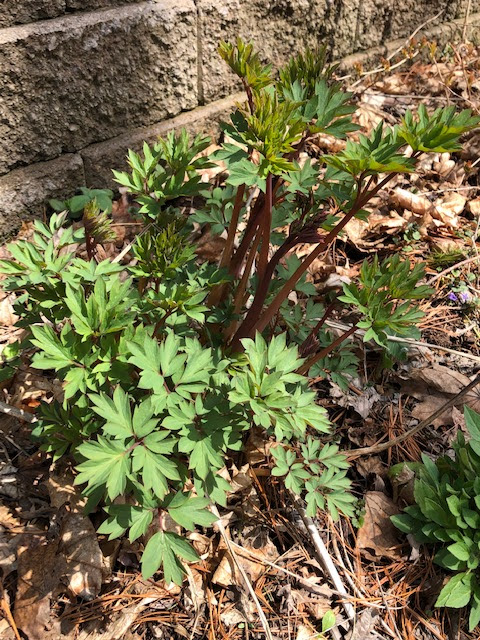
Yes, these bleeding hearts are not a prairie plant. Yet it is special because it was given by Ann N., a volunteer. The plant is a symbol of our friendship and of Ann's generosity.

 Like the pussy willow, bleeding hearts remind me of those on our family farm and in particular, of my Grandma Julia. Bleeding hearts were part of her flower gardens while her vegetable gardens were her true passion. For years the bounty of her gardening labors fed our large family of fourteen children.

 I end with these Virginia Blue Bells, a native woodland wildflower.  Another early spring bloomer that easily spreads. This one is a "self starter" and has reappeared yearly. Bluebell flowers symbolize gratitude and humility or to reflect the last few sentence of Margaret Renkl's poem. 

"I think of that morning—not even a morning,
not even an hour—and I say to myself,
Be an egg. Be a mockingbird. Be a weed."


Friday, January 7, 2022

"Small Kindnesses"

A few weeks ago Kate, a nearby neighbor, posted the following poem on the pedestal in her front yard. Kate regularly posts poems and I look forward to reading them on my daily walks. "Small Kindnesses," the title, is an appropriate intention, or if you prefer the term "resolution," for 2022.   

Small Kindnesses

By Danusha Laméris

I’ve been thinking about the way, when you walk
down a crowded aisle, people pull in their legs
to let you by. Or how strangers still say “bless you”
when someone sneezes, a leftover
from the Bubonic plague. “Don’t die,” we are saying.
And sometimes, when you spill lemons
from your grocery bag, someone else will help you
pick them up. Mostly, we don’t want to harm each other.
We want to be handed our cup of coffee hot,
and to say thank you to the person handing it. To smile
at them and for them to smile back. For the waitress
to call us honey when she sets down the bowl of clam chowder,
and for the driver in the red pick-up truck to let us pass.
We have so little of each other, now. So far
from tribe and fire. Only these brief moments of exchange.
What if they are the true dwelling of the holy, these
fleeting temples we make together when we say, “Here,
have my seat,” “Go ahead — you first,” “I like your hat.
”

As 2022 unfolds may we exchange small kindnesses like the ones I recently experienced. Kindness will help as cope with life's uncertainties which now are heightened because of the Omicron COVID variant. 

One afternoon, early in December, as I was on my daily walk, about a half block from home, a young boy no older than seven and full of joy came skipping out of his house. He quickly and nimbly crossed his front yard and skipped, at a fast pace, across the street to meet me. He warmly greeted me and asked “ Do you want a card from the Kind Kids Club?”

Of course I accepted. He said "thank you" and skipped across the street, returning home as fast as he had arrived in front of me. I had no time to ask his name. I continued my walk and opened the envelope. I laughed as I read the note while feeling joy. I especially liked his "You are looking good" statement. Thank you, young spirit of  kindness. 

June, a neighbor near Prospect Gardens, is another spirit of kindness. Prospect Gardens, as frequent blog readers know, has two elderberry shrubs and two cherry trees. June picked this last summer's crop of elderberries and cherries, and made jams. 

I was on a walk through Prospect Gardens when I met June and her neighbors, Patricia and Jim. I patiently waited as June and Jim finished their discussion. After a warm exchange of greetings, June said that she saved jams for me and this would be a good time for her to get them. Jim and I chatted as June went home to fetch the goodies.

Thank you, June. The elderberry and cherry jams are delicious on toast and with yogurt. Drizzling either one on waffles and ice cream are next on my list. Choosing one or both will be a delight.

Before June arrived with the jams, Patricia came out of the house for her daily walk along the bike path. She asked Jim to  take a picture of us and he obliged before returning home. I usually wear a mask during winter while walking because it keeps my face warm.  

Over the years, Patricia and Jim have extended many acts of kindness to me, their neighbors and family members. I met Patricia shortly after the bike path opened in 2001. She was on the path in front of the tall pine trees, expressing her concerns about the pines' survival. 

Our greetings and chats are small kindnesses that connect us. Jim's stories and quips are often humorous. His story telling reminds me of comedians from the early days of television. Patricia reminds me of a passionate social commentator, a gentle critic, and an activist. She is also a determined walker. You will find Patricia striding down the path even during these cold winter days. 

Holiday seasons offer opportunities for kindness. Laura, a long time Prospect Garden volunteer, gave us this magnificent amaryllis which bloomed for several weeks. Peg, another neighbor and friend, also gave us an amaryllis, along with tasty molasses ginger cookies. Thanks, Laura and Peg. 

Laura "babysat" my bonsai when Ann and I visited Emily in Oakland, California from December 13th to the 20th.  Laura reported that the bonsai was a well behaved plant. 

The last time, because of the pandemic, we saw Emily in person was before Thanksgiving 2019. We were cautious during our visit: eating at outside restaurants and ordering a lot of take out. We  enjoyed a park along the San Francisco Bay in Berkeley, the UC Berkeley Botanical Gardens, and a walk through an upscale Berkeley neighborhood near Emily's apartment. 

Emily and I binged watched the nine part Netflix series, Wanda Vision and several episodes of The School of Chocolate . Follow the link for information about this competitive show, which has some similarities to the popular Great British Bakeoff. 

The medium is chocolate and creations are not chocolate cakes, bonbons, or brownies. During an episode teams competed creating, from scratch, chocolate sculptures that had to be at least five feet tall. One team's sculpture had a base depicting a sea filled with plastic waste and topped with a dolphin. The dolphin fell off just before chef Amaury Guichon, the internet famous chocolate sculpturist, and show's star, began judging the creations. 

The collapsing dolphin added suspense.  Yet what was is noteworthy is how Chef Amaury Guiechon gave feedback wrapped in kindness. For example, he praised the quality of the base rather than focusing on the fallen dolphin. His teaching style was a combination of kindness and criticism, all within the context of a learning experience.

One of our few indoor events was a visit to the UC Berkeley Art Museum. The featured exhibit was "New Time: Art and Feminisms in the 21st Century." Here's a picture of one of the art pieces entitled "Breaking the Prairie" by Koak, a 95 X 68 in. linen mounted panel of oil, acrylic, pigment, chalk and graphite. This was just one of the artist' s several large panels depicting feminism on display. See the Museum's web site for pictures of the featured art and information about the exhibit.   

On our return trip I and other travelers extended a small, yet important, act of kindness to a young man. English was his second language. He was just behind Ann and I in a very long security line. He stepped forward, showed me his ticket and pointed to the time when his plane was boarding. He was rightfully concerned about missing his plane. He asked if he could please move ahead and I agreed. Other passengers also allowed him to move forward.  He made it closer to the front of the line. 

While traveling I wore this Airgami mask which meets all N95 standards. It's made in the United States, reusable and comes with directions for cleaning. Our trip to San Francisco included a three hour lay over in Minneapolis. Ann and I were masked  the entire day. As you can see the mask has a unique origami like design: pricey and worth it because of comfort and breathability. Plus it's unique. 
  
Those who volunteered throughout the 2021 Prospect Gardens season extended kindness and generosity to me and their neighbors. A special thank you to approximately 40 individuals, counting my wife Ann and I, for volunteering throughout the 2021 season. Altogether we logged 340 hours. That’s about 42 eight hour days of interpersonal connections, kindness, fun, and preservation of a site that helps reduce runoff while providing shelter for birds, insects, pollinators, and small animals.  

Here's four recent Prospect Garden winter scenes along with quotations about kindness for your reflection.


“Do your little bit of good where you are; it’s those little bits of good put together that overwhelm the world.” —Desmond Tutu.


  “Human kindness has never weakened the stamina or softened the fiber of a free people.” —Franklin D. Roosevelt.


“Kindness is the only service that will stand the storm of life and not wash out. It will wear well and will be remembered long after the prism of politeness or the complexion of courtesy has faded away.” —Abraham Lincoln.


“My wish for you is that you continue. Continue to be who and how you are, to astonish a mean world with your acts of kindness. Continue to allow humor to lighten the burden of your tender heart.” —Maya Angelou.

I close with this 2020 poem received in this year's Holiday card from the poet Sandy. She is a neighbor, friend, and collaborator on neighborhood projects. 

First Full Snow of Winter

How it softens everything it falls on: 
the slender stalks that bend 
under its wet weight, then lean
into each other to become shelter
for sparrows, a slight lattice
for the plump mourning dove, 
that silly surveyor of our world, 
obvious thief of spilled seed.

And the new stillness after, 
when snow covers everything
         we call it blanketing
so even the energetic finches 
and juncoes stay quiet, 
show excitement only 
in flutters, hops the way
they take their fill
swiftly 
to the closest branch, 
set off snow-spill 
in December air.

The poem was inside this Holiday card and with Sandy's hand written note:

" Sending Fall Harvest cheer to get you through another tough winter of masking et. al ________.
Happy Holidays"

I share Sandy's kindness with you in the spirit of spreading "Fall Harvest cheer." May "Fall Harvest cheer", along with kindness, infuse your life as 2022 unfolds. May it be so.


Thursday, October 7, 2021

"Interbeing" and Joy

A Young Thich Nhat Hahn 

Last July I shared a few of my spiritual beliefs with others during one of our virtual Unitarian Universalist Services. One of my core beliefs is that our lives are imbedded in an interdependent web of existence. We Unitarians are challenged with defining our own theology or world view. We are free to draw from several religious and non- religious sources and traditions.  The Buddha's teachings are one of my sources.

Thich Nhat Hahn, a global spiritual leader, poet, peace activist, and  Buddhist monk coined the word “interbeing” to emphasis the deep interrelationships between all things.  As an example of interbeing, Thich Nhat Hahn refers to a biologist named Lewis Thomas. Thomas says that our bodies are occupied by countless tiny organisms which are even more numerous than human cells. Without these tiny organisms we wouldn’t be able to think, to feel, or to speak. Furthermore according to Thomas , and I quote Thich Nhat Hahn, “The whole planet is one giant, living, breathing cell, with all its working parts linked in symbioses."  

The 95 year old Thiền Vietnamese Buddhist monk now lives in the Vietnam monastery that ordained him when he was sixteen. For years he was exiled from Vietnam. During those years, he established Plum Village, an engaged Buddhist community in France, that now has two monasteries in the United States and others throughout the world. On November 11th, 2014, a month after his 88th birthday and following several months of rapidly declining health, Thich Nhat Hanh suffered a severe stroke. Although he is still unable to speak, and is paralyzed on the right side, he is an inspiration through his peaceful and courageous presence.  Learn more about him: follow this link. 

Autumn especially reminds me of how all beings are interconnected on this breathing Earth and I include sandhill cranes. This one plus a mate and a chick visited Wingra Park across the street from our apartment.  One morning while doing the qigong "crane" movement on our apartment deck, two flew overhead ---human being connected with crane.

 Sara Burr, a Wisconsinite, points out how the cranes are now "markers of the season" in her poem Almost Extinct Once. 

Above us twenty-six red-capped cranes fly 
soundlessly except for the noise of air 
responding to the heave of their wings,
and to their low slide across the sky, teaching 
their juveniles sky-dives and graceful glides. 
Once almost vanished, now a marker of the season, 
the cranes of Dane County depart at dusk 
from their feeding fields, where leavings 
from the harvests are lavish. A village of fellows 
flap and splash about their soggy marsh, 
welcome arrivals.

During October evenings as the sunset
 trails its ruddy fingers along the planet's edge,
 a growing cast in the long grass wetland hoots and rattles, 
gabs with incoming families of three or four and flocks
 of twenty-six or more. The deafening noise of nature vibrates 
through the neighborhood like an alleluia evensong. 
The assembly grows large by November, hundreds 
gather here for their communal journey south, then, leaving
 silence, depart well before harsh winter ice hardens the bog.

While tending Prospect Gardens I often sense  interbeing, as when I reconnected with this friendly black cat. Blackie came sauntering down the dirt section of Prospect Avenue towards the Gardens, tail straight up and meowing a loud "HELLO."  We last met in the Fall of 2020. 

I returned the greeting as Blackie approached for  pets, belly rubs, and ear rubs; all received with pleasant purring. Blackie followed me down the steps where Ann, my wife, was weeding. After receiving more pets from Ann, Blackie continued on his way, tail still straight up. I hope we meet again before winter sets in. Until then, be well.

A few weeks ago, as Ann B. and I were finishing tending the Gardens, we connected with Courtney. Here she is, pausing as she picks up the plant material from Prospect Gardens. Shortly after taking the picture, her team member arrived to assist.  

Courtney is with Madison's City Engineering Division. After each work session, I email her "boss" Ryan for a pick up. Thank you Ryan, Courtney and others who provide these needed pickups. The prompt and efficient extra service is greatly appreciated. 

A shout out to two other City Engineering Staff, Carissa and Maddie. I value our connections and your advice and support freely given over these many years. Thank you. 

Carissa is a landscape architect and Maddie is the Greenway Vegetation Coordinator. Both have major responsibilities for the many green spaces throughout the city. These include rain gardens and the plantings in traffic islands designed to slow down street traffic.

Maddie was instrumental in creating the recently installed Roger Bannerman Memorial Rain Garden across from the intersection of Virginia Terrace and the Southwest Path. Roger, an urban water quality expert for the Wisconsin Department of Natural Resources, championed rain gardens to address flooding and managing rain runoff. Roger pointed out the inter-connections between rain gardens and managing rain runoff, especially during major flooding such as the one that hit Madison in 2018. Many Madisonians held their breath during that flood and filled sandbags as record breaking rain fell, which flooded streets, businesses and basements.  Roger and his wife had three rain gardens in their backyard. The Bannerman’s basement, unlike their neighbors’ basements, did not flood. 
 
Like rain gardens, Prospect Gardens and other prairie gardens along the Southwest Path, maintained by volunteers, are part of a web of inter-dependent connections. Earth, human beings, plants, insects, wildlife, rain, and Lake Wingra are all linked.  Reestablished prairie remnants beautify the earth along the Southwest Path corridor while reinforcing human connections among the volunteers. Prairie plants, with their complex root systems, help reduce rain water runoff from reaching Lake Wingra. Water remains at the sites and pollutants are filtered out by the plants' roots. Migrating butterflies, like this yellow tail, take refuge in the prairies along with monarch butterflies.

 I spotted the yellow tail feeding on Joe Pye weed while walking through Prospect Gardens on a serene late summer day. This prairie plant is the offspring of one received, at least ten years ago, from friends Gary and Jane.  

 Gary and I taught social studies at West Bend West High School during the late 1960s and early 1970s. Gary and Jane were avid gardeners before moving from their home into a senior living complex near West Bend. Their gardens won several community awards. Daughter Jenny is now the avid gardener with bountiful gardens surrounding her home.  Human connections continue to be replenished because of plants. 

Preparing Prospect Gardens for the winter on October 2nd provided more opportunities to feel interbeing. Badger fans streamed by on their way to Camp Randall for the Michigan game, as fifteen volunteers weeded, cut back plants and began thinning out some that are aggressive, such as the tall saw tooth daises. Their large brilliant yellow flowers in early Fall are beautiful. Yet saw tooth daisies are not good neighbors because they grow fast and crowd out other plants. Thinning them is needed to have diversity.  

While preparing the Gardens, connections were made with these seven freshmen from West High. Starting at left side of the top row is Zoe, Lila and Jerry. Sitting in the middle row and starting on the left are Goan, Daniel and Isabelle. Belisma has the bottom row. All but Lila are Leo Club members. Thank you very much.

Thank you Club Advisor Tessa also for renewing our connections. Several times last season club members, now graduates, helped tend the Gardens.  

You all worked hard before and after a break during which all enjoyed Ann B's homemade cheesecake squares. Sorry Goan about the encounter with stinging nettles. My recovery took almost 24 hours and included taking antihistamine. 

Stinging nettles can be both nasty and beneficial. As I took a break from writing this blog and I walked  through Prospect Gardens, I met Andy for the first time.  He was harvesting stinging nettles, anticipating filling the large wooden woven basket strapped on his back.  I learned that during the Fall, stinging nettles have a "flush" of new growth. Andy picks the new leaves as well as the tops of mature plants and uses them in recipes.  Andy assured me that blanching the leaves removes the chemicals that cause stinging. His family favorites include lasagna layered with nettles and other wild plants and creamy nettle soup. Andy brews tea from the tops of mature plants.    Here's a link to a soup recipe for the adventuresome.

Here's Lila and Belisma on a break from cutting back the false indigo. They are best friends. Robert Frost's famous poem still captures the sweet spirit of friendship. While working I am sure Lila and Belisma took time to talk.

  A Time To Talk

When a friend calls to me from the road
And slows his horse to a meaning walk,
I don't stand still and look around
On all the hills I haven't hoed,
And shout from where I am, 'What is it?'
No, not as there is a time to talk.
I thrust my hoe in the mellow ground,
Blade-end up and five feet tall,
And plod: I go up to the stone wall
For a friendly visit.

Ann N. gives a wave as she loads the wheel barrel. Ann is a long time volunteer. Ann brought four dormant Columbines which we planted with hopes they bloom next Spring. Last Fall, Ann provided Columbine seeds which I wintered and planted in early Spring. None came up and I don't really know why.  

Behind Ann N. is Erica who lives a few blocks from the Gardens. This was Erica's first time volunteering. Bill C. was another first timer. Ann R. and her husband, Mark, returned for another time, as well as Jody. The band on Mark's watch broke and after searching for it, we thought it was lost.  After Mark and Ann left, the watch appeared, to my surprise, while I was raking up cut material.  A small event worthy of celebrating. 

Thank you Ann N., Bill, Ann R., Mark, Erica, and Jody. May our connections continue.

Spending time with the West High freshman caused me to recall the friends I made in high school that are life long friends. These early connections have stood the test of time. 

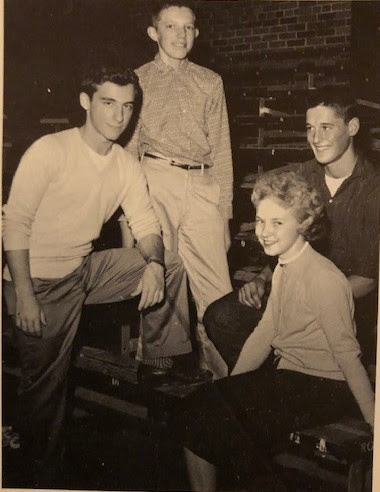
Here's me as a freshman and the year is 1958. I am the tall skinny kid in the center of this class officer picture. Crew cuts were still in style and I had mine until the Beatles arrived on the scene. 

As vice-president, I can't recall what I really did. Probably not much. I remember my classmates Lester and Gary, my lifetime friends. I roomed with Lester and Gary when we all attended UW-Madison. Lester and I arrived in Madison in his 1957 two-tone green Chevy with some apprehension mixed with excitement.

Before attending Madison, we commuted daily to the then UW-Madison two year center in Green Bay. We all lived at home. I recall one trip when Gary was driving a beat up car with very rusty floors in the back seats. A Beatle song was blaring on the radio and I was keeping the beat by stomping on those rusty floors. Gary shouted to quit stomping or my foot would go through those weakened floor boards.

Gary, his wife, Kathy, and Lester and his friend, Eunice, will be with Ann and I for this year's UW Homecoming. Joining us will be my brother Lou, and his wife, Corine, and hopefully my brother Tom and his wife, Todd. Tom had hip surgery in August. We did not celebrate the 2020 Homecoming because of the pandemic. This year will be special as we restart the decades long tradition of celebrating our alma mater, friendship, and family ties.

Sensing "interbeing", as it manifests through friendship, family ties or tending gardens can also include experiencing joy. I offer for your contemplation this poem about joy by Hafiz, a 14th century Persian poet. Thanks Kate for posting this on your front yard pedestal.

Created for Joy

I sometimes forget
that I was created for Joy.

My mind is too busy.
My Heart is too heavy
for me to remember
that I have been
called to dance
the Sacred dance of life.

I was created to smile
To Love
To be lifted up
And to lift others up.

O’ Sacred One
Untangle my feet
from all that ensnares.
Free my soul.
That we might
Dance
and that our dancing
might be contagious.

May you find yourself dancing as the trees change color, the cranes migrate, and the purple aster flowers of Prospect Gardens become brown seeds that will feed birds during the winter. Blessed be. 


A Time To Talk

Robert Frost By more Robert Frost

When a friend calls to me from the road
And slows his horse to a meaning walk,
I don't stand still and look around
On all the hills I haven't hoed,
And shout from where I am, 'What is it?'
No, not as there is a time to talk.
I thrust my hoe in the mellow ground,
Blade-end up and five feet tall,
And plod: I go up to the stone wall
For a friendly visit.


Source: https://www.familyfriendpoems.com/poem/a-time-to-talk-by-robert-frost

A Time To Talk

Robert Frost By more Robert Frost

When a friend calls to me from the road
And slows his horse to a meaning walk,
I don't stand still and look around
On all the hills I haven't hoed,
And shout from where I am, 'What is it?'
No, not as there is a time to talk.
I thrust my hoe in the mellow ground,
Blade-end up and five feet tall,
And plod: I go up to the stone wall
For a friendly visit.


Source: https://www.familyfriendpoems.com/poem/a-time-to-talk-by-robert-frost

A Time To Talk

Robert Frost By more Robert Frost

When a friend calls to me from the road
And slows his horse to a meaning walk,
I don't stand still and look around
On all the hills I haven't hoed,
And shout from where I am, 'What is it?'
No, not as there is a time to talk.
I thrust my hoe in the mellow ground,
Blade-end up and five feet tall,
And plod: I go up to the stone wall
For a friendly visit.


Source: https://www.familyfriendpoems.com/poem/a-time-to-talk-by-robert-frost