Prospect Gardens Summer Time

Prospect Gardens Summer Time
Summer Scene

Sunday, August 23, 2020

Summer Abundance and Beauty

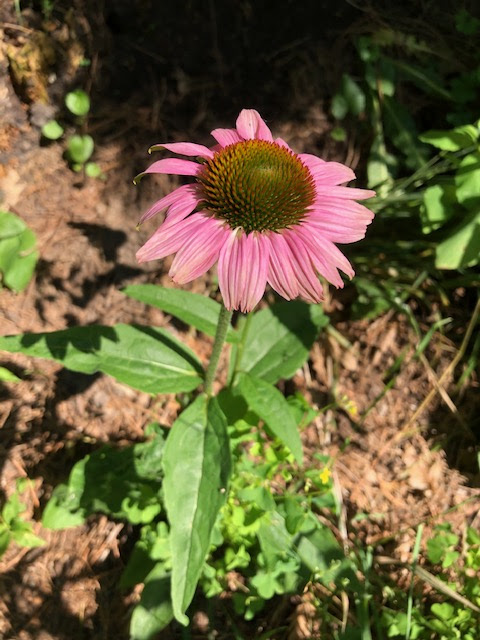
During these summer days while walking through Prospect Gardens I am mindful of the abundance and beauty that surrounds me. The Gardens now are like a Monet painting awash in pinks and yellows with tinges of reds, purples and blues. Phlox, black-eyed susan, tickseed, early sunflower, coreopsis, Joe Pye Weed, purple cone flower, cardinal plant, lavender hysop, and blue lobelia are in bloom. During my visits, I am likely to see a chipmunk scurry across the rocks, a bunny dive into the undergrowth, butterflies, bees, and a Gold Finch perched on the pod of purple cones looking for some early seeds.  

Last week while checking on transplanted plants from a neighbor, Hanns stopped and got off his bike for a friendly chat. Katie, who lives nearby is expanding play space for her three active children which requires removal of several flower beds. I moved lily of the valley, purple cones and ginger to the Gardens.

I so enjoyed the brief visit with Hanns as we talked at an appropriate distance and masked. Hanns has a delightful sense of humor. These brief visits with passersby are even more precious during these days of restricted socializing. Ann and I continue to practice social isolation while missing face-to-face visits with neighbors, friends and relatives. Zoom gatherings, sometimes up to three a week, are an inadequate substitute and yet I value these virtual ties. 

Here's a few pictures showing the abundance of Prospect Gardens along with quotations about gardens. 

"Everything that slows us down and forces patience, everything that sets us back into the slow circles of nature, is a help. Gardening is an instrument of grace. May Sarton (1912-1995): American poet.

"Just living is not enough... one must have sunshine, freedom, and a little flower." Hans Christian Andersen (1805-1875): Dane famous for fairy tales.


"I think this is what hooks one to gardening: it is the closest one can come to being present at creation."  Phyllis Theroux: American children's book writer, born in 1939.

"I want it said of me by those who knew me best, that I always plucked a thistle and planted a flower where I thought a flower would grow." President Abraham Lincoln (1809-1865)


"We learn from our gardens to deal with the most urgent question of the time: How much is enough?"  Wendell Berry: Poet, activist, critic and Kentucky farmer born in 1934.

"Because I am really interested in gardening, I do really interesting plants, not even always flowers. And because I have grown them, I really know them like friends. I paint everything from exotic orchids to rosehips growing wild in a hedge. They just have to speak to me." Emma Tennant (1932-2017): British  novelist  and editor known for her post-modern style.

"A garden is a grand teacher. It teaches patience and careful watchfulness; it teaches industry and thrift; above all it teaches entire trust." Gertrude Jekyll (1843-1932): British horticulturist .

"Flowers always make people better, happier, and more helpful; they are sunshine, food and medicine for the soul." Luther Burbank (1949-1926); American botanist.  


"I know that if odour were visible, as colour is, I'd see the summer garden in rainbow clouds."Robert Bridges (1844-1930): British Poet Laureate . 

“In my garden there is a large place for sentiment. My garden of flowers is also my garden of thoughts and dreams. The thoughts grow as freely as the flowers, and the dreams are as beautiful. ” Abram L. Urban (1899-1963): Prominent African American  Economist

"It's August, and the Joe Pye Weed has appeared in all its glory to announce the coming end of summer. This showy giant native plant gained its common name from a Colonial-era Native American by the name of Joe Pye who used the plant medicinally. This wise medicine man reputedly knew many cures made with the herb “Eupatorium purpureum,” curing fevers, urinary obstructions and typhus outbreaks. Along with its beauty and medicinal qualities Joe Pye is a favorite of pollinators. " Rita Jones/For The Logan Daily News, August 20. 2020. 

H. Jackson Brown, an American author said "Remember that children, marriages, and flower gardens reflect the kind of care they get."  Caring for Prospect Gardens is this bee, pollinating the lobellia.  Recently, Ann B.,  Dave G., Laura, Joyce and Nick have also taken good care of the Gardens. Thank you.      

Thank you to Marcia and Jim for donating the small decorative fence now bordering the Peg Arnold memorial garden. It's the perfect touch. Peg was one of the first volunteers along with her husband Steve. 

Recently Steve moved to Ashland so he could be near his daughter, her husband and their son. I bet Grandpa Steve is enjoying his Grandson. His daughter's dog loved eating raspberries at Prospect Gardens before Steve and I, during our encounters, would notice. 

Another grateful thank you to Marcia and Jim for sharing the abundance of their friend's organic vegetable garden, which is in Appleton. What a generous and tasteful gift. Ann made delicious gazpacho with the heirloom tomatoes, garlic, leeks and cucumbers. The beets, yellow summer squash and the potatoes were just as tasteful. The red cabbage, along with pork chops, made for another delicious dinner. Still another dinner featured homemade tomato soup from several different kinds of tomatoes. 

The ground cherries made a unique pie plus added a new taste to a salad of beets and cherry tomatoes. Ground cherries taste like a cherry tomato injected with mango and pineapple juice, and look like an orange pearl encased in a miniature paper lantern.   

Ann's friend and a former neighbor of ours on Fox, Peg, also shared tomatoes and herbs from their backyard garden.  Thanks, Peg.

The gifts of fresh summer vegetables reminded me of the vegetable gardens and orchards on my family farm. Summer was a time of harvesting. While my brothers and I harvested crops, our Mother canned in the hot kitchen during the entire summer. Windows and the screen door to front porch were wide open in anticipation of a breeze.   

She canned several different kinds of apples from the orchards, vegetables from our garden, Georgia or Colorado peaches, and Door County cherries. Empty jars were brought up from the cool basement into the steaming kitchen and washed. The prepared fruits and vegetables, packed into jars, were stacked into the copper boiler for a steamed bath. Ma, with her hair pulled back and her brow covered with sweat, would pull, at the appointed time, the hot jars from the steaming water.  

By September, the basement shelves were filled with the results of her hard labor. Stored nearby were potatoes, pumpkins, and squash in bins with a dirt floor, crocks of sauerkraut, and an old butter churn full of pickles next to the sauerkraut. The filled storehouse fed us throughout the winter. The massive woodpile and sometimes a pile of coal stored in the basement kept us warm during the long winter days and nights. Sometime in September, I recall hauling the wood with a tractor and trailer to a basement window and tossing the wood into the basement. One of my brothers would assist.  

Prior to getting a gas stove in the late 1940s, Ma, as we referred to her, canned and baked using a wood stove. Somehow she knew how to create and regulate the heat of burning wood. The gas stove stood next to the wood stove. Ma preferred using the wood stove for baking bread because she said wood heat made a better brown crust. I can recall the large tin bread pan full of dough covered with a dish cloth sitting near the hot wood stove rising and eventually bellowing like a cloud. Ma eventually punched the cloud down and divided up the dough into well used darkened tins. If it was early morning Ma would be listening to the "Farm Hour", coming from Green Bay. I can still hear the mellow voice of one of the men as he and his partner chatted about farm topics including the market price of milk, hogs and cattle. 

Ma was well known for her pies. She often used Wolf River apples from one of the orchards. These large apples have pale yellow skin with shades of pale dull red and their flesh is tender, white and creamy. Ma made sheet pies rather than the typical round nine inch pies. Remember Ma had fourteen children and during my elementary school years she was feeding eleven counting her.

Ma in the neighborhood was known also for her homemade raised doughnuts. She often made them weekly. The large harvest kitchen table would be covered with cut out doughnuts waiting to be popped into hot lard. We often ate them when they were still warm and without any sugar or powdered sugar. 

She often shared her doughnuts with neighbors. My sister Theresa walked the mile dead-end road delivering freshly made doughnuts to Katie and Mary Johnson who lived in a house made of logs.  Katie and Mary Johnson were generous, kind, and sweet.  Their house was always spotless and had a sweet smell even though the kitchen had a kerosene cook stove. On the kitchen wall was the wooden box-like phone with the crank on the side. Many neighbors, including us, had access to the phone for fetching the doctor or ordering gas. Katie usually did the actual calling.  

Here is Ma with me in 1962 when I graduated from high school. The farm was already sold and we were about to move into Pulaski.  After the move, Ma still had a garden in the backyard. She made bread well into her eighties as well as apple pie. However, the pies were in nine inch tins and the bread baked in a gas stove. Yet the bread always had a brown crust. She didn't do much canning in town.

When Emily, Ann and I visited, Ma usually offered pie. Sometimes we would have lunch or dinner which included her homemade bread. If we were lucky, polish sausage was on the menu. 

We plant zinnias, one of her favorite flowers, every year in her honor. She died in 1998. There is now a large pot of zinnias on the deck of our apartment just outside my office window.   I close with a poem by American poet Amy Schmidt followed by another poem of blessing.  The pictured zinnias from our deck are a virtual gift to you.

ABUNDANCE in memory of Mary Oliver  

It’s impossible to be lonely
when you’re zesting an orange.
Scrape the soft rind once
and the whole room
fills with fruit.
Look around: you have
more than enough.
Always have.
You just didn’t notice
until now.

Blessing  by Carrie Newcomer 

May you wake with a sense of play,

An exultation of the possible.
May you rest without guilt,
Satisfied at the end of a day well done.
May all the rough edges be smoothed,
If to smooth is to heal,
And the edges be left rough,
When the unpolished is more true
And infinitely more interesting.
May you wear your years like a well-tailored coat
Or a brave sassy scarf.
May every year yet to come:
Be one more bright button
Sewn on a hat you wear at a tilt.
May the friendships you’ve sown
Grown tall as summer corn.
And the things you’ve left behind,
Rest quietly in the unchangeable past.
May you embrace this day,
Not just as any old day,
But as this day.
Your day.
Held in trust
By you,
In a singular place,
Called now. 


Monday, July 6, 2020

Summer Reflections

July 4th, a rather strange holiday given our times, has passed. Here's the neighborhood annual fireworks seen from our deck. The show was short and spectacular, as was the full moon. I have been told that a small group of neighbors fund and carry out the firework. I was glad to again witness the show..

Summer heat with high humidity is converging with spiking of COVID-19 while racial justice protests continue. Tending Prospect Gardens has provided some solace while my birthday is on the horizon. Some of my feelings to all of this is captured by poet and philosopher Kahlil Gibran's (1883-1931) poem "On Joy and Sorrow."  Here's one stanza that summarizes the poem's message.

"Some of you say, “Joy is greater than sorrow,” and others say, “Nay, sorrow is the greater.” But I say unto you, they are inseparable.  Together they come, and when one sits alone with you at your board, remember that the other is asleep upon your bed."   https://poets.org/poem/joy-and-sorrow  for complete poem.

An example of me experiencing the inseparability of joy and sorrow involved these three high school students practicing under the nearby Spooner Street bridge. On June 26th, I was on the return loop of my daily walk. Unlike today's searing 90 degrees, it was a perfect Wisconsin summer day: mild temperatures, blue skies, and a gentle breeze. As I approached the bridge the young men were tuning their trombones. I stopped and listened. They began playing and I recognized Simon and Art Garfunkel's "The Sound of Silence." 

A palpable wave of joy washed through my body. Written in 1964, the song hit its popularity in early 1966. It's now a classic folk song added in 2012 to the Library of Congress' National Recording Registry for being "culturally, historically, or aesthetically important".  My favorite memory of the song is associated with teaching high school social studies at West Bend West High School in 1970.  A student included "The Sound of Silence" in an oral report on music and American culture in a course entitled "American Studies."  

Those were exciting and joyful days in my long education career. I was part of an educational reform that included modular scheduling, team teaching, what is now called project based learning, and a social studies curriculum based on historical themes. For example "The Rise of  American Industrialism" which concluded with a community open house showcasing student displays and projects.

When the three finished playing, and after I thanked them and told them to "Keep on playing your entire lives" a wave of sorrow followed my joy.  I teared up as I walked toward home. I  can't attribute any one reason why I felt so sad. Time certainly has marched on.  Perhaps the sad lyrics themselves were a contributing factor, now experienced through the lenses of multiple crises impacting health, the economy and questions of morality swirling around the "Black Lives Matter" movement.  For lyrics see  https://genius.com/Simon-and-garfunkel-the-sound-of-silence-lyrics  
 
Joy and sorrow intermingled could be the theme of this summer and for the foreseeable future. Here's the first of two poems on the joy side of the pendulum. 

Flowers: Imran Will Suleyman, Architect, Vocalist, Pianist and poet from Kenya. 

"They have no mouth, but seem to speak
A thousand words so mild and meek.

They have no eyes , but seem to see
And bury thoughts into me.

They have no ears, but seem to hear
All my cries, my every tear.

They have no arms, but seem to pat
When with worries my heart is fat.

They have no feet, but seem to walk
Along with me in my dreams and talk.

They, I know, are the flowers so nice
That spread their fragrance a million miles.

Grow a few and then you'll know
How your life is fresh and new.

With a smile so broad, I thank my God,
Whose work to imagine is really too hard."

These blooming Prospect Gardens' plants confirm the poem's message of "Grow a few and then you'll know how your life is fresh and new."  I would add growing flowers is a joyful act. Here's a few for your enjoyment. Thanks to the volunteers who so far this summer have helped tend these Gardens. 

Bee Balm 
False Sunflower

Hosta 

Hydrangea

Native Bee Balm

Purple Cone Flower 

Sun Drop
 
Mary Oliver's "The Summer Day, the second poem, reminds us that summer is also a time of reflection.

"Who made the world?
Who made the swan, and the black bear?
Who made the grasshopper?
This grasshopper I mean------
the one who has flung herself out of the grass,
the one who is eating sugar out of my hand,
who is moving her jaws back and forth instead of up and down-----
who is gazing around with enormous and complicated eyes.
Now she lifts her pale forearms and thoroughly washes her face.
Now she snaps her wings open, and floats away.
I don’t know exactly what a prayer is.
I do know how to pay attention, how to fall down
Into the grass, how to kneel down in the grass,
how to be idle and blessed, how to stroll through fields,
which is what I have been doing all day.
Tell me, what is it you plan to do
with your own wild and precious life?"

  I never really had a plan with detailed goals that I followed, except for knowing deep down that I did not want to remain on the family farm. I was born in this house on a hot July 22nd day, 1944 while my father was shingling a roof on a farm building. This picture is from 1977 and 15 years after the farm was sold in 1962. According to my older brother Leo, I was born in the bedroom behind the windows on the left side of the house. Dr. Shippy delivered me with my Grandma Julia assisting. Leo says he carried the hot water for my first bath in a tin tub. 


Here’s my father and mother, Anton and Anna, shortly after being married. I love this picture. It shows their youth and suggests their optimism. My father was an only child of Leo Blasczyk and Julia Rudnick. After marrying in 1922, the couple moved to the farm owned by Leo and Julia. My paternal grandparents lived with us throughout their lives.  

Grandpa Leo purchased the original 40 acres shortly after marrying Julia on May 16, 1899 from his father-in-law and nine years after Leo came to this country.  Grandfather Leo retired at the age of 50 saying that Americans worked too hard. 

Anton was more ambitious than his father. My father, with a 5th grade education, purchased the farm from his father in 1922. Pa, as we called him, expanded the farm to 120 acres, had the latest farm equipment, electrified the farm and bought the latest household appliances, including a radio. 

According to my brother,Tony my father wanted all his sons to own farms. My father died in 1949 at the age of 49 from complications of alcoholism and when I was four years old. I sometimes wonder how my life would be different if he had lived to a ripe age and free of alcoholism. Would he have accomplished his dream and how would that have affected me ?  

Yet historical forces at the time of his death foretold the demise of the family farm. Farm boys were leaving for factory jobs starting as early as 1920.  My older brothers, as they reached adulthood, joined this historical wave.  According to my brother Leo, he was "Attracted by the big city lights."  Meanwhile the family farms throughout our country were replaced with an agribusiness model. Mega-farms with as many as 8,000 milking cows and employing many immigrants is now the norm. How these industrialized, mega-farms contribute to the climate change crisis is now being understood.   

As I approach my birthday, I have intentions instead of a goal-based plan. I also don't have a "bucket list" that I must accomplish. Being supportive of Ann, my wife and Emily, my daughter is an important intention. I hope to tend Prospect Gardens until this aging body says otherwise because the Gardens are one of my sources of joy. This year I'm feeling more aches compared to the past. The aches fade away after a shower and rest. Appreciating the flow of my aging life with it joys and sorrows, and learning from this flow is yet another intention along with deepening the spiritual side of life. 

Perhaps intentionally noticing and savoring joy in the midst of all the world's suffering seems illogical or an act of denial.  Jack Gilbert maintains otherwise in this somewhat provocative poem. 
A Brief for the Defense: Jack Gilbert 

Sorrow everywhere. Slaughter everywhere. If babies   

are not starving someplace, they are starving

somewhere else. With flies in their nostrils.

But we enjoy our lives because that's what God wants.

Otherwise the mornings before summer dawn would not

be made so fine. The Bengal tiger would not

be fashioned so miraculously well. The poor women

at the fountain are laughing together between

the suffering they have known and the awfulness

in their future, smiling and laughing while somebody

in the village is very sick. There is laughter

every day in the terrible streets of Calcutta,

and the women laugh in the cages of Bombay.

If we deny our happiness, resist our satisfaction,

we lessen the importance of their deprivation.

We must risk delight. We can do without pleasure,

but not delight. Not enjoyment. We must have

the stubbornness to accept our gladness in the ruthless

furnace of this world. To make injustice the only

measure of our attention is to praise the Devil.

If the locomotive of the Lord runs us down,

we should give thanks that the end had magnitude.

We must admit there will be music despite everything.

We stand at the prow again of a small ship

anchored late at night in the tiny port

looking over to the sleeping island: the waterfront

is three shuttered cafés and one naked light burning.

To hear the faint sound of oars in the silence as a rowboat

comes slowly out and then goes back is truly worth

all the years of sorrow that are to come.

Our times sure are marked with sorrow. Yet in the midst of it all, I give praise and thanks for the Queen of the Prairie. The splendid blooms have returned again radiating joy and hope while providing nectar for the bees. Blessed it be.

May you experience joy as the summer and 2020 unfolds while also keeping in mind Kahlil Gibran's message that joy and sorrow are inseparable. Peace and good health to you and your loved ones.


Sunday, June 14, 2020

Fault Lines and Solace

In my last entry I reflected on regaining balance.  Now balance is even more difficult because coping with COVID-19 pandemic has merged with tumultuous forces unleashed by the death of George Floyd and other Black Americans.  Singed in my mind is this Black man faced down on the pavement with the knee of a white policeman on his neck calling out "I can't breathe."  After nearly nine minutes and calling out for his mother, George dies as three other policemen stand by. A tidal wave of protest against police brutality and racial injustice amidst the pandemic swept across the country and continues.

This poem by Robert Walsh gives me solace as I once again seek balance in mind and body. 

 Fault Line
.
Did you ever think there might be a fault line
passing underneath your living room:
A place in which your life is lived in meeting
and in separating, wondering
and telling, unaware that just beneath
you is the unseen seam of great plates
that strain through time? And that your life,
already spilling over the brim, could be invaded,
sent off in a new direction, turned
aside by forces you were warned about
but not prepared for? Shelves could be spilled out,
the level floor set at an angle in
some seconds' shaking. You would have to take
your losses, do whatever must be done
next.
.
When the great plates slip
and the earth shivers and the flaw is seen
to lie in what you trusted most, look not
to more solidity, to weighty slabs
of concrete poured or strength of cantilevered
beam to save the fractured order. Trust
more the tensile strands of love that bend
and stretch to hold you in the web of life
that’s often torn but always healing. There’s
your strength. The shifting plates, the restive earth,
your room, your precious life, they all proceed
from love, the ground on which we walk together.

As I cope with the fault lines and the now "fractured order" tending Prospect Gardens  along with my neighbors and Ann, my wife, also provides solace because I feel the "tensile strands of love" while experiencing the "web of life."  Plus tending the Gardens gives me hope that there will be another spring, summer and fall.  A few days ago I planted wild geraniums that hopefully will survive and bloom during the spring of 2021. That same day I finished planting another new bed of prairie plants, some that will bloom next year.  A final example of hope is a pussy willow shrub donated anonymously that I found near the Fox Avenue stairs.  A note was attached. I planted it in anticipation that the shrub will bloom next spring while understanding that there are no guarantees.

This season because of  the need for social distancing and Dane County guidelines, we don't have the monthly community work sessions. Instead individuals are working on their own. If there are two or more working, each are in different sections of the Garden. Here's Ann N. properly attired.

Volunteers are now members of the Google Group, "Prospect Garden Caretakers." Through this online group we communicate with each other while completing tasks that I describe. Sometimes I include a video of the targeted area. So far this "social distancing" gardening is working. However, I miss the camaraderie of working together.

If you are in Madison and wish to join the Caretakers, please contact me at jblasczyk13@gmail.com. Your work will be greatly appreciated.


It's been a busy season. Here's Dorrie, in late April, retouching the mural. Dorrie, with the assistance of a West High School student, designed and installed the mural nine years ago. I wonder what the student is now doing?  Thanks Dorrie. She redid the bike mural on the concrete slab last season.

As Dorrie worked on the mural, Ann B., Laura and I, wearing our masks, transferred the Garden's wheelbarrow, hoses and tools from Laura's basement to Hanna's garage, which is closer to the Gardens. Thanks Hanna for providing your garage.  For about four years, we stored the gardening stuff in a shed located within the bike right-away next to Ernie's and Jeanne's lot. They sold their home late last fall and we temporarily stored the gardening stuff in Laura's basement. The shed, covered with lead paint and falling apart, was no longer an option. Last week the shed was torn down.

Clearing out and then mulching the raspberry patch was the first actual gardening task of the season. Ann R. and her husband, Mark, did the mulching after Bob and his wife, Jane, did most of the weeding. An unknown person had already cut back the raspberries canes, which was exactly what they needed. Thank you Ann R., Mark, Bob and Jane. Also thank you Ann B., Laura, Ann N., Ruth, Joyce, Loren, Amy and Amy's son Koen for volunteering. All this generosity of your time and work is greatly appreciated.

Hopefully, we will have a good raspberry crop. Passersby, such as grandparents and their grandchildren, will once again stop and be nourished while enjoying themselves and the Gardens.  I am sure sharing raspberries strengthens, to quote from the poem, the "tensile strands of love" between grandparents and their grandchildren.  

The two cherry trees, planted several years ago, look healthy and are now mature. An abundant crop for both birds and humans looks promising.

The notorious and tenacious Bishops Weed (BW) continues to be our collective challenge. Almost all volunteers have worked on the BW invasion. Here's the terraced section on the Regent side that required total rejuvenation. Thank you Maddie, from City Engineering, and Nate, a neighbor, for the new plants. Special thanks to Marsha and Jim for donating and applying the mulch. Marsha also weeded the Peg Arnold memorial garden and with the assistance of Jim mulched the area. This section now looks spectacular.

Our efforts to address Bishops Weed reminds me of  Carl Sandburg's poem "Weeds."

From the time of the early radishes
To the time of the standing corn
Sleepy Henry Hackerman hoes.
There are laws in the village against weeds.
The law says a weed is wrong and shall be killed.
The weeds say life is a white and lovely thing
And the weeds come on and on in irresistible regiments.
Sleepy Henry Hackerman hoes; and the village law uttering a ban on weeds is unchangeable law. 

By no means are the volunteers or me a "Sleepy Henry Hackerman".  But nevertheless, Bishops Weed "come on and on in irresistible regiments" while we enforce the unchangeable law.  Bishops Weed, unfortunately for us spreads rapidly through seeds and deep roots. You could say it is a repeat offender or at least a clever adversary.  

While planting the terrace, Barb, a friend, passed by on her bike. She stopped, pulled down her face mask to exchange greetings. My mask is around my neck. When the bike path is crowded or when talking with a neighbor, I slip into the mask. She took the picture and shared it with this lovely poem by Mary Oliver.  Her poem notices and celebrates nature. Thanks Barb. 

This World

I would like to write a poem about the world that has in it
nothing fancy.
But it seems impossible.
Whatever the subject, the morning sun
glimmers it.
The tulip feels the heat and flaps its petals open and becomes a star.
The ants bore into the peony bud and there is a dark
pinprick well of sweetness.
As for the stones on the beach, forget it.
Each one could be set in gold.
So I tried with my eyes shut, but of course the birds
were singing.
And the aspen trees were shaking the sweetest music
out of their leaves.
And that was followed by, guess what, a momentous and
beautiful silence
as comes to all of us, in little earfuls, if we’re not too
hurried to hear it.
As for spiders, how the dew hangs in their webs
even if they say nothing, or seem to say nothing.
So fancy is the world, who knows, maybe they sing.
So fancy is the world, who knows, maybe the stars sing too,
and the ants, and the peonies, and the warm stones,
so happy to be where they are, on the beach, instead of being
locked up in gold.

Golden Alexander 
Lilacs 
In the spirit of Mary Oliver I share pictures of a few plants from Prospect Gardens.  They contribute to our "fancy world" and are "happy to be where they are."  May we too savor moments of happiness during these unsettling times.  

Daisies and Spider Wort
Jack-in-the-Pulpit 


Pink Spider Wort 
May Apple 
Gardening is a solace for many others throughout the nation during these tense times. Many state guidelines, including Wisconsin's, classified greenhouses as essential businesses. A June 9th segment on PBS' NewsHour featured notable Dutch garden designer Piet Oudolf and how he finds solace in his magnificent gardens. Reporter Jeffrey Brown said that plant sales at greenhouses are now at an all time high. Klien's on East Washington was sure busy when Ann and I, with masks on, ventured out on May 22nd and bought plants for the six pots on our deck.

Piet Oudolf designed New York City's High Line Gardens located along abandoned railroad tracks. See High Line  for more information about these spectacular urban gardens. When I dream about the future of prairie gardens along the Southwest Path (also following abandoned rails), I envision a High Line landscape rather than separate gardens.

While I find solace in tending Prospect Gardens, escape from feeling the fault lines of the pandemic and from the brutal death of George Floyd is impossible. Both now mean we have a "fractured order."  Returning to the so called "normal", which we hear so often in the media, as the poem "Fault Lines" suggests is also impossible. Instead we must summon courage to accept our "losses" and  strengthen the "tensile strands of love that bend and stretch to hold" us within "the web of life that’s often torn but always healing."  To me this now means intentionally and vigorously addressing inequality, poverty and our long history of racial injustice. 

A first small step we can all take is heeding this message on the boarded up window of a Monroe Street Business: Listen.  This includes voices we may not like to hear and asking us to look deeply into our own beliefs, attitudes and how our society perpetuates inequalities and racism

May you experience solace and peace during these times of worldwide suffering.   


Monday, April 20, 2020

Regaining Balance

As COVID-19 continues I’m aware of my different perceptions of time. My last entry was March 21st. On one level this feels like yesterday. Yet this last month feels like time has dragged on and I am lost in a time machine that has gone a muck. Still on another level, I know that we are experiencing what Buddhism refers to as impermanence; that is, what we consider reality is always constantly changing from moment to moment and this unpredictability is a reality of life. It is our minds that want a constant and a "new normal."

During this pandemic at times I want a constant or at least some sense of balance. I am like those referred to in Sharon's McDonald's poem "A Prayer for the Dazed." 

For those whose "check engine" light just flashed;
For those recently deposited, trembly-legged, from a roller-coaster;
For those who forgot their lines as they entered, stage right;
For those poised tensely like a deer in the headlights;
For those badly jet-lagged who fumble for their passport;
For those just awakening not sure of their name;
For those who sat near as a loved one died a "good" death;
Oh God, we pray, repeat yourself:
Vouchsafe again and again the law of gravity;
Reiterate that day follows night and crocuses follow icicles;
Push the tides endlessly like a rocking cradle
Until we can recognize the rhythm of our own breath;
Until we can blink and regain our balance;
Until our hearts beat steadily again

Regaining balance is a challenge during this COVID-19 pandemic. A recent visit to Prospect Gardens to check out the emerging spring helped me to regain balance, at least for the time of my visit. Here's what I discovered.

These white Hyacinths greeted me and I rejoiced. They were a gift and after the blooms faded, I put the three bulbs in a closet. Last fall I planted them: Hyacinths followed darkness and the icicles of winter.


The McDonald poem says to recognize the law of gravity. Tending Prospect Gardens also teaches respecting the laws of nature and to abide what Lao Tzu said: "Nature does not hurry, yet everything is accomplished."

The history of this Forsythia confirms Lao Tzu's observation.  It was planted eleven years ago and hardly bloomed until this year. Now it's in full bloom in the midst of a pandemic. Beauty in nature co-existing with society-wide dread of COVID. A balanced contradiction.

I did nothing to encourage the Forsythia in overcoming its own daze. It's a mystery about how and why that happened. May this Forsythia grace the Gardens as the years unfold. Meanwhile this year's blossoms broadcast that spring is here.

Another mystery and a special delight are Daffodils, one of my favorite flowers. Somehow bulbs found their way into the Gardens. Maybe a squirrel dug up bulbs from a neighbor's yard, brought them over, buried and forgot them.

Seeing the Daffodils again reminds me of my year (1975) in Monmouth, Oregon. I was attending Oregon College of Education completing Oregon's special education certification. On a spring day when the rains stopped I drove out into the country in my trusted 1950 Ford, which I named "Fred Ford".  Actually Fred Ford at times was not to be trusted, but I never worried about it. Occasionally, at a stop light his engine would cut out for a few minutes. I would patiently wait and after a brief rest, Fred Ford would be ready to move again.

On that particular day in the country, Fred Ford purred along. Once I got out of Monmouth, which didn't take long because it's a small town, fields full of Daffodils greeted me. Such delight on an overcast Oregon day. The memory is still fresh in my mind.

These Siberian Squill have also found their way into Prospect Gardens and to my delight. There were none a few years ago. I marvel how these early signs of spring spread on their own. They seemed to be more abundant this year and are lasting longer, perhaps because of the cool spring weather.

Siberian Squill is a favorite spring flowers of Emily, my daughter, who now lives in Oakland, California. I sent her a text with a picture of a large patch of Siberian Squill from along Edgewood Drive in Vilas Park.

The Bay area was one of the first areas to shelter-in. Ann and I were relieved when Emily began working from home on March 11th. Normally, she commutes daily on the Bart into San Francisco for her job with Ancestry.com.

 This small patch of Red Trillium has also returned for another season and is worth celebrating. Trillium, unlike Siberian Squill, take their time spreading. A few years ago, this patch was much smaller; four or five plants. I still recall being happy when I first discovered them.

Their foul smell flowers attracts carrion flies that act as pollinators. Early herbalists used this plant to treat gangrene, since, according to the Doctrine of Signatures, plants were used to cure the ailments they resembled.

I would like white Trillium in the Gardens which I had in the backyard of our former home. Maybe they too will mysteriously show up on their own. Or, a neighbor will offer some, as has happened with other plants in the past. I'm more selective today but I definitely will accept white Trillium.   

 Grasses are reappearing which confirms what L.M. Montgomery said about spring: "That is one good thing about this world ... There are always sure to be more springs."

I transplanted this one from the Glenway Prairie and Wildflower Areas. I volunteered at the Glenway during the first year of its development and before Prospect Gardens.  That was when I met Sandy, Glenway's crew chief, who encouraged me to develop areas near the Prospect Avenue intersection. Development began about two years later.

Now with shelter-at-home extended through May 26th, some kind of plan for tending the Gardens is needed. The usual once a month community work sessions are impossible.   Most likely, as in the past, a solution will emerge and the needs of the Garden will once again be met. Gardening is always an unpredictable journey. I will try to stay balanced as this COVID phase continues to unfold.

 The Hostas are once again poking their way through dead and decaying leaves. We didn't anticipate or want these common perennials along with native prairie plants when we first laid out plans for Prospect Gardens.

A few neighbors offered Hostas or they were left on a neighbor's curb and I hated the thought of them going into the landfill. So now we have a shade garden with Hostas, Jack-in-Pulpits, Jacob's Ladders and several different kinds of ferns, all donated or salvaged.

In short, we started with a plan that favored an unfolding development rather than strict adherence to a plan. Perhaps this approach reflects the Garden's early origins. Before we began intentionally developing Prospect Gardens in 2010, Ernie, a neighbor, and I followed a "Guerrilla Gardening" approach; meaning we would slowly reclaim areas without any plan.  Guerrilla Gardening is a world wide movement. I have a book about it; a gift from my daughter, Emily. For more information see https://www.guerrillagardening.org/ggtips.html.


Pictured here is My Grandmother Julia with Jenny, her  oldest Grandchild. Jenny made her first Holy Communion. I am guessing that Jenny is about thirteen. Catholics made their First Communion in their early teens. So the date is most likely 1937.

Grandma Julia was an avid gardener, but she was not a guerrilla gardener. Planning began early in spring and about this time of the year, the garden plot along our driveway would be renewed.

Tony, my older brother, tells the story of how he rode and guided the white and black spotted horse while Grandma held down and maneuvered the hand held cultivator. She was a strong women who also worked out in the fields. While small in stature, according to family stories, she outworked any man on any day.

Jenny told the story how she, as a teenager, and Grandma Julia made hay with my Dad during a hot summer; "He was sweating bullets."  Mowed hay was loaded on a wagon using a hay loader and brought to the barn. Jenny and Grandma moved the hay in the hot barn loft after a large bunch of hay was released from hay forks that ran along a rail in the peak of the loft. Empty, the forks returned to the wagon on the barn floor and Dad placed them around another punch of hay.

These hay forks were attached to a thick rope which ran through pulleys. The rope was pulled by a horse down the embankment next to the barn. The loaded hay forks rose into the air and eventually screeched across the rail. Dad tripped it and with a bang the hay fell into the mow. The horse backed up the hill while younger sisters and brothers pulled the rope up the hill and stacked it into a neatly rolled pile.  The process started all over; all day long in the summer heat.

Several decades later (late 1950s) my older brother Tom had my Dad's role. My brother Louie and I took turns driving the tractor pulling the thick rope down the embankment. You had to drive slowly and steady with no jerking. One of us, along with Ernie, my younger brother, pulled the rope back up the hill as the tractor backed up and then the rope was stacked.  A chopper, purchased by Tom and Ma, eventually replaced this way of making hay.

Grandma's huge vegetable garden fed our large family even during winter. We were totally food self-sufficient. Something I think about, our own independent food supply, as I put on my mask and go shopping at Metcalfe's during this pandemic. Yes, being food self-sufficient was hard work, but lack of food never entered our minds or for that matter, concern about not enough toilet paper.

During summer we enjoyed fresh vegetables, watermelon and muskmelons.  During winter, potatoes, pumpkins and squash were in our basement on dirt floored areas. Cabbage made into sauerkraut filled stone crocks taller than me when I was a child. Pickles in old butter churns covered with a plate held down with a stone, stood next to the sauerkraut. My Mother's canned apples from our orchard lined wooden shelves along with cherries and peaches that she purchased. Wood was brought into the basement during late fall to feed the two wood stoves.

Visible from our kitchen windows was Grandma Julia's large flower garden. Her garden included roses, many peonies, gladiolas, iris, and geraniums.

I suspect that Grandma Julia also knew how to regain balance throughout her life. She was born on April 15th, 1882 in Chicago and lived in Polish neighborhoods around a large Catholic Church that still stands today, Saint Stanislaus Kosta. At that time it was the country's largest Catholic Church with 3,000 attending several Sunday masses. The young Julia Rudnick moved with her family to a farm near Pulaski sometime in 1887. On May 16, 1899 seventeen year old Julia married my Grandfather Leo who was thirty-four. My oldest sister Jenny said it was an arranged marriage.

Julia and Leo moved a few miles from the Rudnick farm on forty acres purchased form Julia's father, Jacob, about a month after they were married. This was our home farm. Julia worked with Leo to clear the land. She almost lost her only son and my Father, Anton, from scarlet fever when he was a young child. She experienced the 1918 Influenza pandemic when she was thirty-six, and lived during  two world wars and the Depression.

My father Anton married my Mother Anna on November 14, 1922. They moved in with Grandma Julia and Grandpa Leo. Both grandparents lived with our family until their deaths. My Mother and Julia had a close relationship and worked together as a team. According to family stories, the two very seldom argued and if they did, they quickly made up and gave each other a hug, saying in Polish "everything is all right."

Grandma Julia witnessed the death of her husband on March 10, 1943. His coffin sat in the living room of our four square house. Six years later on March 2, 1949 her forty-nine year old son and my Father died. Until her death on February 15, 1951 she worked along side my older brother Mike in an all out effort to keep the family together and the family farm going. She worked almost to the time she died. I remember her feeding pigs a few days before she died.

So perhaps regaining balance is in my DNA or at least I have Grandma Julia as a prime example.  Incidentally she was kind, generous, and dearly loved all her Grandchildren.

Remembering her and being mindful of spring at Prospect Gardens and elsewhere helps me breath, appreciate beauty and regain a sense of balance during these uncertain times. I end with Mary Oliver's poem that celebrates spring through the eyes of children. May you be safe and healthy.

Children, It's Spring

And this is the lady
Whom everyone loves,
Ms. Violet
in her purple gown

Or, on special occasions,
A dress the color
Of sunlight. She sits
In the mossy weeds and waits

To be noticed.
She loves dampness.
She loves attention.
She loves especially

To be picked by careful fingers,
Young fingers, entranced
By what has happened
To the world.

We, the older ones,
Call in Spring,
And we have been through it
Many times.

But there is still nothing
Like the children bringing home
Such happiness
In their small hands.


Saturday, March 21, 2020

Web of Life

Saturday, March 21st, another day of social distancing and volunteer isolation is ending as COVID-19 unfolds. The sun is casting a yellow hue on the buildings across the street as the sun sets. Somebody just picked up a take out order from the partially closed Indian restaurant. Take out only. Traffic on the once busy Monroe Street is reduced to a trickle.

COVID-19 reveals our vulnerability while underscoring how we are all interconnected regardless of race, gender, class, and nation.  In fact, as Chief Seattle (1786 – June 7, 1866), a prominent Suquamish and Duwamish chief, points out all things are connected.  We are enmeshed into a web of life.

"This we know: All things are connected
like the blood that unites us.
We did not weave the web of life,
We are merely a strand in it.
Whatever we do to the web, we do to ourselves." 


Prospect Gardens are just one strand in the web of life. This little strand is connected to others along the Southwest Path.  Perry, a neighbor, likes to refer to this interconnected web as "shared habitat."  Perry lives along the Path, about a ten minute walk west of Prospect Gardens. This poster is on a tree next to the Path and in the backyard of Perry's house. Perry made and tacked it to the tree when he and others waged a losing campaign against lights along the Path during the Fall of 2012.

"Shared habitat" captures the spirit of Chief Seattle. The poster shows a Great Horned Owl, which I once saw along the Path.  Perry reports that because of the installed lights the Great Horned has moved further into neighborhoods bordering the Path. Perry says that he still hears the Great Horned Owls but they no longer nest along the Path.
 Perry, during the winter of 2012, captured how Great Horned Owls stash prey and use food to attract mates. They mate for life, but are solitary except for mating season. This frozen mouse is about 5 feet above the ground.


Sharp-shinned hawks also share habitat along the SW Path. Here's one looking like a Buddha. A few years ago as I was walking home from work, one swooped passed me and caught a small bird in mid-flight. Follow this link for
 a little drama Perry caught between a Sharp-shinned Hawk and a squirrel . A window will open and afterwards close the tab to return.

This Red Tail, common in North America, is another strand in the web of life. They soar above open fields, slowly turning circles on their broad, rounded wings. You’ll see them atop telephone poles eyes fixed on the ground to catch the movements of a vole or a rabbit. Last summer a young Red Tail flew overhead as I was on the Path. After landing in the tree, the youth kept calling its parent with its high pitched screech.

Thanks Perry for these two pictures and the video clip. You are a keen observer.

Joining the Red Tail Hawk in the web of life along the Southwest Path are the Turkey Vultures. Janice, a friend, photographed this majestic soaring bird. They return each year and roost in the pines just off the path near the Path entrance into the Nakoma neighborhood. The Vultures are just passing through. Maybe they are on their way to Devil's Lake near Baraboo, where they will spend the summer months gracefully soaring in the air currents over the lake and the bluffs..

Last week I witnessed seven vultures as they soared over the pines. You too, can share the joy by: going to Janice's video.  A window will open and then close the tab to return.

Another bird in our shared habitat is the Sand Hill Crane.
Here's one I encountered last summer near Lake Wingra. These solitary birds seem to be adjusting to human beings. They nest in the nearby UW Arboretum. Last week, during my walk, at least six flew overhead calling to each other, announcing their return and telling me that spring is here. They make a distinctive croaking sound.


Cardinals, Blue Jays, Goldfinches, Robins and other birds live near or visit the Path.  During April, Spring Warblers linger in thickets along a stream just off the Path. Here's the tiny Ruby-Crowned Kinglet. They are fast-moving birds. If you’re watching a flock of Warblers, you might see one dart into view and keep moving through the foliage, almost too fast for you to keep up.

As you walk or bike along the Path, and if attentive, you will hear the tap-taping of wood peckers such as this Downy Wood Pecker. Yellow-bellied Sapsuckers and Northern Flickers may also be heard. Another great picture, Perry.


Animals share the habitat bordering the Path and we are connected to them in the web of life. Here's a deer and a data point for a study led  by Professor David Drake from the Department of Forest and Wildlife Ecology. He and Sheryl Hursh, a PhD candidate, are studying mammal diversity and mammal size (large and small). Their study is part of the Urban Wildlife Information Network. Twenty-three USA cities and one in Canada participate in the study. I met both, on different occasions, during my walks on the Path.They expect to offer suggestions about managing wildlife in a mid-sized city and how urban planning decisions may affect wildlife patterns.

Coyotes also inhabit the Path corridor.  Follow this link to see one in Perry's backyard   Fox, possums and of course, squirrels and chipmunks reside in the Path corridor.

Prospect Gardens and other prairies along the Path are sanctuaries for small animals and insects and notably Monarch Butterflies. The Dudgeon Monroe Prairie at the intersection of the Path and Odana is a stop for hundreds of butterflies as they migrate and make their way to California and Mexico.  Here's one. Some also check out Prospect Gardens.


Bees, under threat from pesticides and disease, find solace in the Prairies. This one is harvesting nectar from Prospect Garden's Monarada, commonly know as Bee Balm. The decreasing bee population underscores Chief Settle's message and in particular "Whatever we do to the web, we do to ourselves."  Harm to these important pollinators has serious ramifications on our food supply. 

The decrease in bees is so troublesome that robotic bees are being tested in almond orchards near Esparto, in the Capay Valley region of central California. Our faith in technology is boundless. For more information see this NPR article.

I end this entry about a few sentient beings who share our web of life with a Mary Oliver poem. Chief Seattle would agree with her message.

Sleeping in the Forest
I thought the earth remembered me,
she took me back so tenderly,
arranging her dark skirts, her pockets
full of lichens and seeds.
I slept as never before, a stone on the river bed,
nothing between me and the white fire of the stars
but my thoughts, and they floated light as moths
among the branches of the perfect trees.
All night I heard the small kingdoms
breathing around me, the insects,
and the birds who do their work in the darkness.
All night I rose and fell, as if in water,
grappling with a luminous doom. By morning
I had vanished at least a dozen times
into something better.

from Sleeping In The Forest by Mary Oliver

© Mary Oliver