Prospect Gardens Summer Time

Prospect Gardens Summer Time
Summer Scene

Sunday, June 6, 2021

Open the Hatch - A Blessing for a New Opening In Life

On May 2nd, our church, the First Unitarian Society, called the Rev. Kelly Weisman Asprooth-Jackson to be our Co-minister. He, along with Rev. Kelly Crocker, will have co-equal status as senior ministers and will function as a team.  Kelly just celebrated her twentieth year as our minister, starting as a contracted assistant minister.  

Kelly AJ, as he will be referred to, handed me this poem during a "drive through welcoming event" after the congregation overwhelmingly voted to call him. He wrote the poem. The poem expresses the promise of our new type of ministry as well as the promise and challenge as we continue to transition from the pandemic. 

A Blessing for a New Opening in Life

The scent and beauty of the flower,
Is formed out of light, and water, and earth; 
It is not all contained within the seed, 
Yet the idea of it is.
With each moment that opens before us,
We cannot know all that will come after;
Nevertheless, we can choose to make a beginning.
May the way become clear,
But rather than wait until it does:
Let us plant the seed,
Draw the breath, 
Set out upon the journey, 
And open the hatch.

The journey of caring for Prospect Gardens continues. The hatch was initially opened twelve years ago and with each spring the hatch is reopened. 

On a balmy Saturday, May 22nd, seven volunteers joined Ann B. and I.  A perfect late spring day with a light breeze that made for comfortable weeding. West High School Leo Club members returned once again. 

Here they are tackling Bishops Weed. Misha is on the right, Sydney in the middle, and Olivia on the left. Misha was with us during our last work session while this was the first time for Sydney and Olivia. The three quickly and effectively removed the tenacious Bishops Weed. Thank you.


Sydney and Misha on a well deserved break under a blue sky with white fluffy clouds. 


Olivia during a break. Come back again. You are now an experienced Prospect Gardens caretaker. 

And here's Sydney striking a pose. You too are now an experienced Prospect Gardens caretaker and we would so welcome your return.

All three Leo Club members are sophomores ending a very unique year. Next school year will have new beginnings and offer opportunities for opening hatches. May you all enjoy the summer.


Annette, a nearby neighbor, joined the gang. This was Annette's first time. Thank you, Annette.  You are a quick learner and now an intrepid volunteer. We will welcome you any time you have the urge to garden. 


Hanns, an experienced volunteer, focused on removing the fading dandelions from throughout the Gardens. I always enjoy Hanns' humor and wit. Glad to be gardening with you again.  Thank you.
Here's Nick busy pulling--- guess what---- Bishops Weed! Thank you Nick for once again tackling the self-renewing Bishops Weed. This year is an especially good one for Bishops Weed. Some have flowered and the lacy blooms are pretty.  Oh my.....am I developing a soft spot for this challenging weed? 

Laura and my wife, Ann B., the two remaining volunteers, escaped my prying camera. Thank you to both of you.  Ann B.  makes sure we take a break with treats. I affectionately call her the "union steward."

Also contributing to the Gardens and not pictured are nearby
neighbors, Marcia and Jim. The couple, without being asked, have weeded and mulched for several years the Peg Arnold memorial garden. This year they mulched the area under one of the cherry trees. They provided the mulch for both areas and  for another section which I reconfigured. Their generosity is greatly appreciated. Plus our chats are always enjoyable. Thank you for being good neighbors. 

Twelve years ago when Steve A. and I were planning the Gardens, we talked about including art. Quite spontaneously four sculptures by Marcia's beloved sister, Patty, are now installed. 

This piece is made of white marble and rests against a rock I brought in when the memorial garden was developed. The little birds, which Marcia added, are just the right items.  

The circle of the sculpture reminds of a hatch. I wonder where in leads to?  What does the sculpture evoke in you?

This piece is a porotype for a large sculpture that Patty never completed before she died in her mid-sixties. It would have been at least four feet tall. 

I said that Patty's sculptures spontaneously became part of the Gardens. On a Saturday morning, I arrived early to plant two wine cups (callirhoe involucrata) donated by Jane H., a nearby neighbor, and to finish mulching the section that I reconstructed. Thank you Jane for your special gift. 

While I was picking up the mulch from Marcia and Jim's driveway, we begin to chat.  During our chat, Marcia mentioned her beloved sister, Patty. Well, one thing led to another, and to harken back to the poem, the hatch opened and art made its way into the Gardens. 

Here's Patty with the fifth piece that may be installed in the Gardens. It's white marble and Marcia says it's heavy. How to situate the heavy piece and how to move it into the Gardens could be challenging.  

How Patty's art became part of the Gardens fits a pattern I have experienced throughout the history of the Gardens. Hatches open and things appear at the right moment. 


Here's  another example of how  things appear at the right moment. It's a mobile of pottery bells and beads which now compliments the nine bark blossoms that spill over the old weathered picket fence.

A few days ago, Ann B. and I met Sandy, the crew chief of Glenway Prairie, to dig up Pennsylvania Sedge and prairie Jacob's Ladder. These were to be transplanted into Prospect Gardens.  

When we finished digging the plants, a man came walking by and stopped to talk first with Ann B., and then Sandy and I joined in. He was carrying the mobile. He asked Ann B. for directions to the nearest gas station which Ann B. relayed to me. I asked if he needed a bathroom. He replied "no" and was looking for a job. Perhaps he was homeless and I never asked. Sandy and I gave directions to the nearest gas station which is on Speedway. 

I like mobiles and have made a few. So his mobile caught my attention. I said something to the effect, "That's an interesting mobile."  In a soft voice he asked if I would like to have it and that he would accept any offered sum. Ann B. and I quickly agreed, and I handed him ten dollars.  He thanked us, smiled and left in the direction towards the gas station on Speedway while saying: "God bless you."  

Here's Sandy after we dug up the plants.

Still another "open the hatch" experience is the June 1st work session with a crew of seven young men from Operation Fresh Start (OFS) and their two leaders. Maddie, City Engineering's Green Space Coordinator, provided the crew. OFS is a program that serves youth ages 16-24.  Thank you Maddie. 

Here is the hard working crew. Robby, the newest Conservation Supervisor, is standing in the front, left side. Starting at the top left on the stairs is Juan, Taylor, the experienced Conservation Supervisor , Axel, and Muntadher.  In the middle of the stairs and sitting is Mitchell, his first day in the program. Next to him is Reece and in front of Reece is David.  Standing on the right is Alexis. 


After introductions were made and a brief orientation, the crew went to work. Under Robby's guidance, a group cleared out several different kinds of weeds along the Regent side. Robby first identified several weeds, pulled them out, laid them in row, and then told his students about each one. This helped his charges to tell which weeds to pull.

Another group worked with Taylor to remove ditch lilies that encircled a cherry tree. Digging ditch lilies is definitely a young person's job. Many of the removed lilies were there when the trains slowly passed by. Tubers are numerous, compacted and deeply rooted. Just when you think you got them all, more turn up as you dig deeper. 

Weeding and digging those hardy ditch lilies saved me so much time and labor. Plus now air circulates around and through the cherry tree. Please come back when the cherries are ripe. The ripe raspberries will also be waiting for you. You all deserve these treats.

Here's David during a well deserved break. I sense that you and other OFS crew members understand one of  the messages within Rev. Kelly AJ's poem. 

"With each moment that opens before us,
We cannot know all that will come after;
Nevertheless, we can choose to make a beginning."


Muntadher looks relaxed after working hard. The best to you and to your fellow crew members. All of you have opened hatches. It was a pleasure spending a sunny late spring morning with all of you.
Spider Wort 
 Here are pictures of seven plants that are benefiting from the generosity of all the mentioned volunteers. 
Golden Alexander 
Blue Indigo 

Milk Weed Loved By Monarchs

A Species of Lilac 
A Species of Primrose 


Columbine 


The columbine, the golden alexanders, and lilacs are fading. Summer and fall plants are waiting for their time in the sun. 

May and June offer new beginnings for our graduating youth.  Here's my nephew Vince celebrating the college graduation of his oldest son, Cole. Several weeks later, Luke (on the left) graduated from high school. His brother Ben (on the far right) has already graduated and is involved in body building competitions.  As my brother, Leo and the boys' Grandfather, often said: "Fine boys." And indeed they are. 


In 1962 I graduated from Pulaski High. Here I am with my mother. That was a year of several new beginnings and the way was not always clear. 

In April, 1962, the family farm was sold. Along with my younger brothers, Ernie and Louie, we moved into Pulaski on Front Street across from the high school. Louie worked for the Red Owl grocery store in Pulaski. I first packed pickles for John Wood's Pickle-Right and then the bean factory before going to the then Stevens Point State College. I disliked Stevens Point. After one semester, and unclear about the future, I transferred to a two year UW Center that is now the University of Wisconsin-Green Bay. I lived at home and commuted to the Green Bay campus.

The way became clear as I entered my junior year and enrolled at the UW-Madison. My friend Lester and I arrived in Madison in his 1957 green Chevy. Lester kept that car spotlessly clean. I still recall my excitement as we traveled down Johnson Street, heading toward the University and moving into an apartment shared with my brother, Tom, Lester and Vedo, a Ph.D. student. We lived in an apartment with two large rooms. 

Lester and I slept in bunk beds and Tom in a bed on the opposite side. Vedo created a space for his single bed in the corner of the second room that also had a kitchen. His space was surrounded by his beloved books. Vedo had a large briefcase to carry his books. Briefcases were very popular. My budget did not allow for one.

We always made it a point to have dinner together. Weekly we rotated who would cook and who would do the shopping. If I recall right, this was Vedo's stipulation.    

I knew I would complete my degree as I went from building to building to register and appear in front of tables staffed with individuals. If a class was open, you signed a sheet and handed in a punch computer card. If not opened, you scrambled to find an alternative.  Beforehand, I carefully mapped out the locations of the several buildings spread across campus involved in the chase for classes.  

After I completed registration, I sat at the base of the Lincoln statute taking in the view and savoring being in Madison. Another student approached me and asked me for assistance because he was having a difficult time registering and couldn't find the next building to hopefully enroll in a class. I offered assistance while feeling confident about the journey that lay ahead. 

Now here I am reminiscing about the past and noticing instances of Kelly AJ's poem.  At this moment I am once again drawn to these phrases: 

"Draw the breath, 
Set out upon the journey, 
And open the hatch." 

So the journey continues and another 90 degree day unfolds. Ride the Drive, a biking event on the closed streets of our neighborhood, is now history. I rode the two mile course along with many others, including parents and their children. 

I close with sharing these two small painted rocks that I unexpectedly found in Prospect Gardens. Katie, a neighbor, thinks a little girl on the next block created them. Katie say it's the latest ritual stressing sharing. When you find a painted rock,  you are to leave one of your own that you decorated. 


Thursday, May 13, 2021

Gratitude Once Again and Reminiscing


Once again, as Spring continues to unfold, I am filled with gratitude for all those who over the last twelve years have tended the Prospect Prairie Gardens or contributed in some other way. For example, several years ago Steve, who was also a regular volunteer, arrived one day with what looked like a stick having hair-like roots. Steve assured me that the stick was a red bud. Now a corner is filled with brilliance. 

Steve now lives in Ashland near his daughter, her husband and his grandson. I often think of Steve when I pause and admire this red bud. This red bud and others, apple blossoms in the UW-Arboretum, and flowers in neighborhood gardens seem more brilliant this year. Is it just me? Or maybe the side effects of the hopefully receding pandemic? 

Speaking of the pandemic. Ann and I are cautiously venturing out. On April 27th we met in Appleton, my brother Lou, his wife, Corine, my nephew Mike and his wife, Cathi, for a long overdue visit and lunch at Pullman's. We talked for a long time after enjoying our lunch. We were the last ones to leave the restaurant after nearly a two and half hour stay.  On May 7th we had pizza with friends Bob and Claudia at Ian's in the renovated Garver Mill. Siting outside was a little chilly. Two of my small groups are now meeting outside instead of on Zoom.  

Earth Day included tending the Gardens. Thank you Ann R., Amy and Dave for being part of this first official 2021 work session. Thank you Joyce and Percy who worked earlier in April.

Saturday, April 24th, was a special day and another reason to be grateful. These three members of West High School's Leo Club and their advisor, Rick, arrived and were ready for serious gardening. Pictured, starting at the left, are Misha, Maddie and Frosya. All three are sophomores.

These members of Generation Z have a very strong work ethic. The three, along with Rick, quickly and effectively mulched the raspberry patch and another section. They ended the three hour work session with cutting back plant remnants and weeding.  

The students wore masks because they were not yet vaccinated. Ann and I are fully vaccinated, but wore masks when near the students. Plus all of us practiced social distancing. This season, unlike last year, small groups of volunteers can now tend the Gardens. Maintaining social distancing is still recommended and easy because the Gardens cover about 6200 square feet.  

Here's Frosya cutting dried stalks left over from last season. You can see the new growth below the clippers. Frosya quickly cleared this section of the Garden. 


Here's Misha with a handful of dried plant material. Just a pause before she went back into action. I bet there is a smile behind that mask.


Our three diligent gardeners are in front of the pile of plant material that resulted from their labor. Camera shy advisor Rick also worked hard. Thank you Rick. 

                                              
Tessa and Olivia (top)
Last Saturday, May 8th, Misha and Frosya returned to again lend a helping hand. Olivia and the new Leo Club advisor, Tessa, joined the team. Tessa is a nurse, a West High School graduate, and former Leo Club member.

Misha, Frosya, Olivia and Tessa first took up the challenge of removing waterleaf from the Hosta Garden. After removing the waterleaf, the Leo Club team moved to other sections of the Garden.

Waterleaf is one of those plants that is a great ground cover but spreads rapidly.  Whether waterleaf is classified as a weed depends upon location and individual preference. Let's just say, waterleaf was not a good neighbor to the hostas, the jacob's ladder, the jack-in-the pulpits and other woodland plants. I must say I had some hesitancy about evicting the waterleaf. 

 
Joining us was Isabel (Isa), an Edgewood College sophomore majoring in elementary education. She is on our scheduled break. Metcalfe's cookies were offered. 

Isa also was a diligent worker and seemed to enjoy weeding the east end of the hosta garden. Isa, sometimes bent over, made her way up the steep slope while listening to music. Thank you Isa for your good work. 

Isa is a Bonner Leader. The Bonner Leaders Program provides scholarships to selected students who are committed to community service and learning about social issues and social change. Students spend two to four years working with a team of other Edgewood College students on specific community service initiatives. Leaders meet regularly as a group to learn about social justice issues, community leadership, and civic engagement. Sending gratitude to Virginia, the Bonner Program Coordinator, who made the connection with Isa.
 
Laura With Scissors 
Two neighborhood volunteers joined  the weeding brigade. Here's Laura. Laura is sometimes camera shy and  hides when I want to take a picture. Her gardening scissors make an interesting addition to her face mask. 

Thank you Laura for your long term commitment to Prospect Gardens. If I am recalling right, she was one of the first volunteers twelve years ago.  

Found this on the Web and I think it's meant for Laura.

LAURA

L:  LUSTER, you shine!
A: AGREEABLE, the best side of you
U: UNDERSTANDING, you show others
R: RADIANT, it's your personality
A:AFFIRM, the certainty of knowledge


Here's Ann R., another stalwart and hard working volunteer. Ann has been volunteering now for several years. Ann's husband, Mark, sometimes joins Ann. 

The name Ann is of  Hebrew, English origin and means "grace".  "Grace" has several definitions, including "simple elegance" and "courteous goodwill", and these words certainly describe Ann.

Ann lives in the Regent neighborhood. The Regent Neighborhood Association and the Dudgeon-Monroe Neighborhood Association jointly sponsor and financially support the Gardens. Another bow of gratitude to these two neighborhood associations and to Ann R.

Working with the Leo Club reminded me when I taught sophomores at West Bend, West High School. The year is 1971 when teachers wore shirts and ties.  Note my long hair and sideburns. 

Now, the barber cuts what is left of my hair in less than 10 minutes (pandemic time cut by Ann-one half  hour). My dear mother-in-law, Ethel, once commented: "Jake, since I have known you, you have lost a lot of hair." She was a resident at St. Mary's Care Center. Ann and I were visiting her and during a quiet time she looked at our wedding picture, glanced at me, and made the truthful assessment. 

Here's me listening to a student delivering a report. Students often researched topics and presented in small groups, such as this one.  I was a third year teacher and team taught with Bill Bast. We taught a course entitled "American Studies." Bill had a Ph.D. and loved teaching. He chaired the Social Studies Department. 

We were on "modular scheduling" and in a newly opened high school; actually two side-by-side high schools that shared common facilities. Modular scheduling meant we met students in different configurations. Small group discussions were the dominant mode of instruction. Lectures were used to introduce units and presented to all enrolled sophomores assembled in a large room.  

We did not use a textbook. Instead, the curriculum consisted of thematic units; for example, a unit on American Industrialization. This unit ended with students presenting their projects during a fair attended by community members. Many students made posters and museum like exhibits and were available for comments with attendees.  

We had a resource room stacked with paperbacks and other learning materials that students used. We met individually with students who were academically challenged or were experiencing problems. If needed, we created special assignments or had students report to the resource room for extra help by the teacher's aide in charge of the resource room.

Those were good days; filled with excitement, challenge and rewarding. During my last eight years of my long educational career I had the great fortune of being the coordinator of an evaluation unit which was part of a natural resource center, now the UW Natural Resources Institute. My interest in prairie gardens is an extension of those eight years working with individuals who cared deeply about this interdependent world we inhabit. 

Thanks for staying with this tangent down memory lane. I end with gratitude for one of my favorite poets, Mary Oliver. Here's her poem " Spring in the Classroom" with its delightful ending. 

Spring in the Classroom

Elbows on dry books, we dreamed

Past Miss Willow Bangs, and lessons, and windows,

To catch all day glimpses and guesses of the greening

 woodlot,

Its secrets and increases,

Its hidden nests and kind.

And what warmed in us was no book-learning,

But the old mud blood murmuring,

Loosening like petals from bone sleep.

So spring surrounded the classroom, and suffered to be 

    kept indoors,

Droned through lessons, carved when we could with 

    jackknives

Our pulsing initials into the desks, and grew

Angry to be held so, without pity and beyond reason,

By Miss Willow Bangs, her eves two stones behind glass,

Her legs thick, her heart

In love with pencils and arithmetic.

So it went—one gorgeous day lost after another

While we sat like captives and breathed the chalky air

And the leaves thickened and birds called

From the edge of the world -- till it grew easy to hate,

To plot mutiny, even murder. Oh, we. had her in chains,

We had her hanged and cold, in our longing to be gone!

And then one day, Miss Willow Bangs, we saw you

As we ran wild in our three o'clock escape

Past the abandoned swings; you were leaning
All furry and blooming against the old brick wall 
In the Art Teacher's arms.


Monday, April 5, 2021

Haiku Spring, Memories and Hanna's Gift

Spring continues to unfold while we reach a possible turning point in the pandemic. Hopefully, the increased pace of vaccinations means the virus is no longer in control.   Yet, public health officials warn us to be cautious and to continue practicing safe measures because of the spread of variants. If not, we could have another surge of infections. A hard message to sell to those craving a so called return to normalcy. 

Meanwhile, our neighborhood is blessed by a Great Horned Owl which makes this a special spring. The honored neighbor is in a tall pine tree a short distance from our apartment, at the northeast corner of Knickerbocker and Cross Street.  

This picture is from the Web. The nest is to the left and above the owl. According to a neighbor there are at least two owlets. I have seen one. The  baby is a big white fluff ball with huge eyes. I will continue visiting and quietly watch as the owlets proceed on their journeys. May they be safe and protected.

The owl's presence stimulated an exchange of haiku with my friend Barb R. 

Barb                                                                          Jake 
                                                                                   
Pine green swaying boughs                          Pine and healing sun
Cradle hidden owlets safe                            Horned owl not home today
Needles whisper sleep                                   Spirit still refreshed 

Here are seven pictures of spring emerging in Prospect Gardens. I continued to experiment with haiku. 


New shinning red orb
Unwanted by a near neighbor
Spirit--health and life
 

A neighbor on nearby Commonwealth Avenue didn't want the orb and placed it on a pile of leaves near the curb. I happened to see her in the front yard and after receiving permission gently carried the orb to Prospect Gardens. She was pleased that the orb found a new home.  


Garden visitor
Guest to be warmly welcomed?
Pesky intruder?

Laura, one of our faithful volunteers, spotted this being and emailed me the picture.  It didn't move even while her dog, Cozmo, barked at it.  Initially, I thought it was a rat while Laura said maybe a young ground hog. After a discussion with her sister, Laura now thinks it's a muskrat, even though no water is nearby. Perhaps curiosity caused it to venture out of the nearby sewer.  No more reported citing, to my relief.


Columbines resting
Seeded under Fall skies
With no expectations


 Thanks again Ann N. for harvesting the seeds from your backyard. They will emerge and grace the Gardens.  


Picture by Laura 


Now a decade old
Forsythia blooming again
Youth and joy return


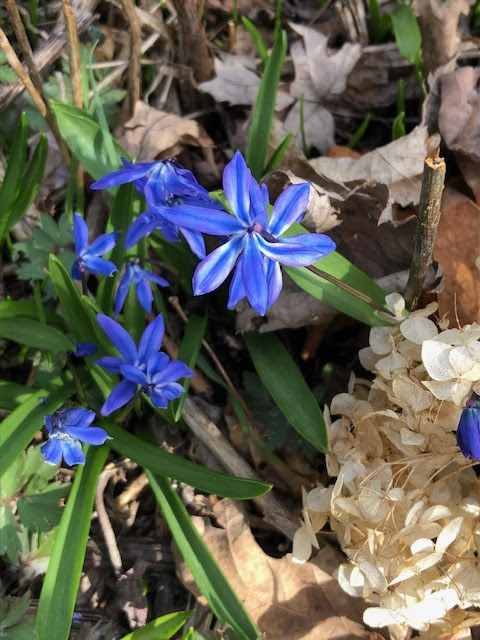
Siberian Squill
Early deep blue delicate blooms
Such fleeting beauty


One of my favorite early spring flowers. So happy that they have found their way into Prospect Gardens. No help from me or anybody. The magic of nature.


Ditch Lilies rise
Here when freight trains passed by
Now bikers fly by


Trilliums show up
Commonly called "wake robin"
Red blooms announce spring!


Budding Hyacinth 
Soon calming blue simplicity
Take note passersby


Sharing my memories of past springs and Easters through haiku seemed dauting. Prose will have to do. My childhood and teenage memories of spring include Lent, the six preparatory weeks before Easter and the holiday itself. My mother made sure that we at least heard the priest's message to give up something for Lent. I no longer remember what I specifically gave up, but I recall it was something not too taxing. 

Every Wednesday night we attended Stations of the Cross at the large Catholic church in the center of nearby Pulaski. The church was always packed. We attended church on Holy Wednesday, Holy Thursday, sometimes on Holy Saturday, Good Friday, and on Easter. 

Services on Good Friday started at noon and ended about three hours later. All village businesses were closed, including all taverns. Parking was at a premium and if you didn't arrive early you stood in the back of the church. We always arrived early.  

The ritual I recall most involved kissing the feet of Jesus. Two altar boys, in white cassock-like robes, supported a large crucifix situated at one end of the church's very long center aisle. The crucifix rested at an angle in front of the main sanctuary. Shortly after entering the opposite end of the aisle you got on your knees and slowly made your way to the crucifix at the other end with others all around you. Once you kissed the feet, one of the altar boys would wipe Jesus' feet.  Definitely something that would be prohibited during the pandemic.

A less arduous and more enjoyable ritual was accompanying the Easter basket of food prepared by my mother to church for a blessing. Ma packed a green metal basket that once held cookies purchased from Cook's Coffee.  The Cook's Coffee man in an orange and black van, packed with goods, appeared occasionally at our farm. I wonder why Ma bought that basket of cookies. I still remember the sale and how surprised I was that the man convinced Ma to buy the shiny green basket of cookies. We usually did not have money for such luxuries, as store made cookies. Perhaps she had some extra money from selling eggs to the owners of Hussin's General Store in nearby Pittsfield. 

The repurposed basket was perfect for the blessing ritual. Ma packed the basket with ham, Polish sausage, hard boiled eggs, homemade bread, some butter, salt and pepper and something sweet like her donuts or pies. The shiny green basket stood out among the other baskets lined up along the alter railing. The priest, in white vestments, said the blessing in Latin, and with several flips of the wrist, sprinkled holy water over the opened baskets. If you were nearby, beads of holy water fall upon you. The blessed food was served at breakfast at our home. We attended Easter Sunday mass and had a special meal sometime during the day, as well.

Of course, there was no exemption from daily farm chores. Animals were fed, cows milked, and manure removed. Plus during spring, calves were sometimes born and they required special attention. Teaching them how to drink milk out of a bucket was a challenge. If it was a warm day, the cows were released into the barnyard and they ran around like children during recess.

By early April, our pond and the creek overflowed with rushing water. Sometimes the water would almost reach the house. The frogs along the banks sang. Robbins and other birds joined the pleasant chorus. Apple trees in the orchid next to the house turned green and buds were ready to bloom. Peace and tranquility reigned as the cycles of life and rebirth moved forward.

Swallows returned to build their nests in the eves of the gabled roof barn. Red Wing Blackbirds swooped overhead as you made your way through the swamp section to the mailbox at the end of the mile dead end road. Gophers popped their heads out from their burrows along the road while Killdeers called out as they quickly skipped across the road in front of you.

At school before the Easter holiday, we made paper baskets. One of our teachers (I think it was Ms. Falkowski) collected and filled them with jelly beans and a chocolate bunny. One year, a late snowstorm closed school after Ms. Falkowski packed the baskets and placed them in a closet. When we returned, she sadly announced that mice had eaten much of the candies. I recall my heart sinking. There was no Easter candy for me, my brothers and my sisters.

Our daughter Emily fondly recalls the Easter baskets she received from her Grandmother, aunt and uncle and us. She recently told me that what she really liked was looking for the baskets. She was much more into the search process than the final outcome. 

Ann and I had a quiet Easter. I am fully vaccinated while Ann will have a second shot on April 8th. We continue to be cautious. 

We participated in our church's virtual Easter service. Our ministers and staff creatively captured and communicated the Easter message of renewal and rebirth following a period of suffering.  When we will have in person services remains unknown.

Around noon, Ann and I enjoyed our traditional Easter brunch. We savored the last piece of incredible chocolate from the nearby Madison Chocolate Company, corner of Glenway and Monroe Streets. 

In the evening we had our weekly phone call with Emily. We have not seen her in person since shortly before Thanksgiving 2019. It's been a long time and we hope to see her later this year. 

Meanwhile the joys of spring are to be savored and enjoyed. Here's Billy Collins' praise of  spring. 

Today

If ever there were a spring day so perfect,
so uplifted by a warm intermittent breeze

that it made you want to throw
open all the windows in the house

and unlatch the door to the canary's cage,
indeed, rip the little door from its jamb,

a day when the cool brick paths
and the garden bursting with peonies

seemed so etched in sunlight
that you felt like taking

a hammer to the glass paperweight
on the living room end table,

releasing the inhabitants
from their snow-covered cottage

so they could walk out,
holding hands and squinting

into this larger dome of blue and white,
well, today is just that kind of day.

From Aimless Love: New and Selected Poems by Billy Collins 

Spring is a season of generosity as suggested by Bill Collins' poem.  I was totally surprised by Hanna's generous gift of this shed that now holds Prospect Gardens' tools, hoses and wheelbarrow. What an incredible gift that will keep on giving. Thank you very much, Hanna. 

Shortly, the twelfth season of tending the Gardens will commence.  Ann and I already took down the orange snow fences. Those of you in Madison please consider volunteering. Your generosity would be greatly appreciated. 

Please contact me at jacob84@charter.net and I will provide further details. Volunteers are the reason why our neighborhood has Prospect Gardens rather than a weed and invasive space. 

Peace and well being to you and your loved ones. 


Monday, February 15, 2021

"May You Live in Interesting Times": A Curse or a Blessing?

We are in the depth of winter. Last night the temperature dipped to -9 degrees. The sun is back after several days of low hanging clouds. Night time subzero temperatures will continue for several days.

In the midst of this winter, we continue moving through unprecedented times. Climate change is increasingly obvious, raising the question if we have entered the sixth mass extension. The pandemic wages on while vaccines are slowly being distributed. Asking if you got a vaccine shot is a common question among my friends. The Capitol was ransacked on January 6th, halting the certification of the election for several hours. Joe Biden and Kamala Harris were inaugurated with nearly 25,000 National Guard troops on stand by. Trump's second Senate trail is history.  

In passing, I mention the Super Bowl with all its hype, greed and a distraction for many, but not so much for me. I tuned in occasionally. The half time show was beyond my comprehension, while reminding me of the chaos of our current times. 

"May you live in interesting times" supposedly is the English translation of a traditional Chinese curse.  I will leave it up to you as to whether our times are a curse or a potential blessing. I think it's a little of both. A curse because these times are emotionally draining and full of suffering; especially for the loved ones of those nearly 483,000 who have died. Feeling vulnerable, exposed, and anxious about the future is a norm for most of us. At the same time, we may be in a midst of a transformation towards a new order.  Joanna Macy, environmental activist, and scholar of Buddhism, general systems theory, and ecology, writes about the "Great Turning." Here's what she had to say in a 2009 article:

"The Great Turning is a name for the essential adventure of our time: the shift from the Industrial Growth Society to a life-sustaining civilization. The ecological and social crises we face are caused by an economic system dependent on accelerating growth. This self-destructing political economy sets its goals and measures its performance in terms of ever-increasing corporate profits—in other words by how fast materials can be extracted from Earth and turned into consumer products, weapons, and waste. A revolution is under way because people are realizing that our needs can be met without destroying our world." https://www.ecoliteracy.org/article/great-turning

Regarding pandemics, New Yorker author Lawrence Wright, investigates the history of pandemic in a July 13, 2020  article entitled, "How Pandemic Wreak Havoc---- And Open Minds."  https://www.newyorker.com/magazine/2020/07/20/how-pandemics-wreak-havoc-and-open-minds.

Wright asks this question in his introduction to the article: "The plague marked the end of the Middle Ages and the start of a great cultural renewal. Could the coronavirus, for all its destruction, offer a similar opportunity for radical change?"

Wright, along with Gianna Pomata, a retired professor at the Institute of the History of Medicine, at Johns Hopkins University, tells us about the history of the plague and its effects. Here's just one of the fascinating comments: 

 "Pomata told me, “What happens after the Black Death, it’s like a wind—fresh air coming in, the fresh air of common sense.” The intellectual overthrow of the scholastic-medicine establishment in the Middle Ages was caused by doctors who set aside the classical texts and gradually turned to empirical evidence. It was a revival of medical science, which had been dismissed after the fall of ancient Rome, a thousand years earlier. “After the Black Death, nothing was the same,” Pomata said. “What I expect now is something as dramatic is going to happen, not so much in medicine but in economy and culture. Because of danger, there’s this wonderful human response, which is to think in a new way.”

Are we thinking in new ways as Pomata hopes we are? I see some signs. General Motors recently announced their goal of eliminating gas and diesel fuel vehicles by 2035 and replacing all with electrical ones. Working at home is now acceptable by large corporations like Google. The pandemic has heightened our awareness of social and economic inequalities while underscoring how deeply interconnected we all are. The January 6th insurrection points out the fragility of our democracy. Seeing clearly is often the first step towards right action.  

Locally, a group of Madison citizens is thinking in new ways about development. They have created a non-profit and launched the "Save the Farm!" campaign, an effort to redevelop a 65-acre property on Madison's far eastside. The former Voit farm is ripe for development and for sale. I drive past the Milwaukee Street property on my way to the dentist. The barn, silo, and home still stand.

The non-profit hopes to buy the farm and develop the property in unconventional ways. They imagine a "purpose-built neighborhood that incorporates core values of anti-racism, diversity/inclusion, affordable housing, urban agricultural and environmental sustainability." 

An investment cooperative is being organized, allowing ordinary citizens to purchase shares. The campaign is now determining how many would potentially be interested in buying shares.  Ann and I have indicated our interest. If you are interested, please see https://www.savethefarm.net/   You provide contact information and how much you may want to invest, without any obligation to follow through.

I see signs of thinking and acting in new ways in my neighborhood. The Dudgeon-Monroe Neighborhood Association now has an Anti-Racism Committee, formed in 2020 in response to concerns about systemic racism in our community. Here's the mission statement: "We connect the Dudgeon-Monroe neighborhood to issues of racial equity in a way intended to inspire action and policy-making towards dismantling systemic racism." For more information see https://www.dmna.org/antiracism

Another neighborhood example of thinking in new ways is a subaward proposal Sandy and I, as co-chairs of the Southwest Path Committee, just submitted to the UW Arboretum. The Arboretum received an Environmental Protection Agency grant to promote stormwater community engagement and education at the neighborhood level. If funded, along with our partners, we plan to install two 400 square feet rain gardens on park land adjacent to Wingra School, and conduct educational outreach activities. Activities involve Wingra School teachers, staff and families, as well as residents of the Dudgeon-Monroe neighborhood and other nearby neighborhoods.

Rather than just emphasizing best practices, we take a wider perspective towards stormwater.  During a "kick-off" Community Gathering for 60 residents, a member of the Ho-Chunk nation will be invited to offer a local Indigenous perspective on water. We hope that this offering linked to Traditional Ecological Knowledge will inspire participants to reframe stormwater management as water stewardship.  Wingra School, after rain gardens are installed, will also invite members of the Ho-Chunk and Ojibwe speaking Nations to share plant names in their respective language, and explain the multidimensional meaning language and words have in their cultures. With this base of knowledge, signs will be made for plants that include Ho-Chunk, Ojibwe, Spanish and English languages. 

I am optimistic that we will be funded. We will need volunteers. If you live in the Madison area and are interested in volunteering, please contact me at jblasczyk13@gmail.com. There are several ways of lending a hand, which I will gladly explain when you contact me. 

I like to think that our eleven year effort involving Prospect Gardens is another example of thinking in new ways. The prairie plants with their deep roots keep rain water at the site while beautifying a previously ugly, weed-invested site. Otherwise the rain water would find its way into the ditches along the bike path and eventually into a stormwater drain and into Lake Wingra. 

The raspberry and gooseberry patches provide snacks for passersby. The cherry trees and the elderberry shrubs likewise offer food for both birds and humans. Neighbors, while volunteering and afterwards, have developed deeper connections. Prospect Gardens' future depends upon volunteers and the need is constant. Please contact me at jblasczyk13@gmail.com,  if you are interested in lending a hand. 

Prospect Gardens now are covered in deep snow patiently waiting for spring. In late January, prior to the arrival of the deep snow, I took the following pictures while visiting the Gardens. January, if you recall, was quite mild.  These pictures testify to the beauty of the Gardens, even in late January. I offer these along with quotations for your reflections. For me, Prospect Gardens continues to teach me to look at and experience life in new ways.

“Among our Potawatomi people, women are the Keepers of Water. We carry the sacred water to ceremonies and act on its behalf. “Women have a natural bond with water, because we are both life bearers,” my sister said. “We carry our babies in internal ponds and they come forth into the world on a wave of water. It is our responsibility to safeguard the water for all our relations.” ― Robin Wall Kimmerer, Braiding Sweetgrass: Indigenous Wisdom, Scientific Knowledge, and the Teachings of Plants


"As I walk with Beauty
As I walk, as I walk,
The universe is walking with me,
In beauty it walks before me,
In beauty it walks behind me,
In beauty it walks below me,
In beauty it walks above me,
Beauty is on every side."

—Traditional Navajo Prayer


“I don’t think that it is more technology we need, or more money or more data. We need a change in heart, a change in ethics, away from an anthropocentric worldview that considers the Earth our exploitable property to a biocentric, life-centered worldview in which an ethic of respect and reciprocity can grow."  

Robin Wall Kimmerer, Returning the Gift, Minding Nature May 2014


“Before I can tell my life what I want to do with it, I must listen to my life telling me who I am.”

Parker J. Palmer, Let Your Life Speak: Listening for the Voice of Vocation


  “Whether we and our politicians know it or not, Nature is party to all our deals and decisions, and she has more votes, a longer memory, and a sterner sense of justice than we do.”

― Wendell Berry


“Progress is impossible without change, and those who cannot change their minds cannot change anything.”

George Bernard Shaw


“We have forgotten how to be good guests, how to walk lightly on the earth as its other creatures do.”

—Barbara Ward


Spring will surely arrive, the Earth will thaw, and the plants pictured above will once again rise up. I end with this poem by Jane Kenyon and her message of imagining spring. 

February: Thinking Of Flowers 

Now wind torments the field,
turning the white surface back
on itself, back and back on itself,
like an animal licking a wound.

Nothing but white--the air, the light;
only one brown milkweed pod
bobbing in the gully, smallest
brown boat on the immense tide.

A single green sprouting thing
would restore me. . . .

Then think of the tall delphinium,
swaying, or the bee when it comes
to the tongue of the burgundy lily.