Prospect Gardens Summer Time

Prospect Gardens Summer Time
Summer Scene

Wednesday, October 30, 2019

Transitions and Letting Go

October 29th was a day of transition. I rolled out of bed at about 6:45 a.m. and quietly made my way to the office in the fading darkness. I glanced out the window before doing my Tai Chi routine and meditating. Fresh snow blanketed the deck and this container of petunias. For a few minutes I sat and reflected on how over night autumn transitioned into winter. Carl Sandburg's poem captures the moment.

Autumn Movement

I cried over beautiful things knowing no beautiful thing lasts.
The field of cornflower yellow is a scarf at the neck of the copper sunburned woman, the mother of the year, the taker of seeds.
The northwest wind comes and the yellow is torn full of holes, new beautiful things come in the first spit of snow on the northwest wind, and the old things go, not one lasts.

As the day passed winter slowly transitioned back into autumn. The warm brilliant sun continued melting the snow as I walked in the afternoon under a brilliant blue sky. The contrasting red and white in this picture captures both seasons I experienced and enjoyed during my walk.

I also happened to notice the last of this Fall's raspberries as I passed a patch that spilled over the white picket fence near the sidewalk. The ripe berries caught my attention.

 As I finished enjoying the tart berries and returned to continue my walk,  a flock of migrating Robbins snacking on crab apples on a nearby tree caught my attention. Some were this year's off springs, perhaps on their first passage south.

Many Robbins scampered away only to return to the feast after I passed.They were not ready to move on. Yet I bet they understand the message meant for us in Walterrean Salley's poem.

Summer's passed already,
October’s nearing the end.
Trees are gently balding-
Leaves riding the wind.

On the great “fall” canvas,
Colors begin to change—
From plush green to red,
Yellow, brown and orange.

The sun will soon hide
As the chill settles in.
Then the cold will roar—
Nipping at the chin.

Unpack the boots and scarves,
The sweaters and the tights;
Prepare to “settle in”
For some long wintry nights.

Late October is also transition time for Prospect Gardens.  During the morning of October 18th, this small crew of Amy, to my left, and Ann R. to my right, along with my wife, Ann prepared the Gardens to "settle in for some long wintry nights."   After two hours we accomplished our goal with a break to enjoy Ann's homemade pumpkin bread. 

Thank you all for your help. Together we shared a beautiful autumn day.


I now wait for more snow to protect the Gardens from the inevitable freezing cold.  A few more sunny autumn days would be appreciated. Another walk in the arboretum or a stroll on  Picnic Point would be pleasant. Perhaps a Babcock ice cream cone?  I would favor a Michael's Custard, but unfortunately the one across from our apartment has permanently closed. Ann and I often lunched at Michael's after working in the Gardens. 

The large "For Lease" sign makes me sad as does the reason why Michael's closed. It's gone because of how immigration laws are now enforced. Owner Michael Dix's spouse, Sergio De La O Hernandez, is an undocumented immigrant in the United States for thirty years.They married in 2015.  Hernandez manged daily operations at the Monroe Street store. Dix sponsored Hernandez for a U.S. visa so Hernandez could obtain legal status in the country. When Hernandez returned to his home country of Mexico last August for a visa interview, he was denied the visa and denied re-entry into the United States.

And so Michael's Custard, a thirty year old Monroe Street fixture, transitions into the unknown, nothing compared to what Michael and Sergio face. Perhaps as this final poem on autumn suggests, letting go and facing the unknown are more of autumn's messages. The author, Rev. David Bumbaugh, is Unitarian Universalist minister who once served a Summit New Jersey congregation. 

Dancing in the Wind

Except for a few stubborn holdouts
the tree outside my window
is bare of leaves.
The wind,
this October morning,
worries those few remaining leaves,
pulling them this way,
twisting them that way,
tugging at them
until, one by one,
exhausted by the ceaseless effort to hang on,
they go dancing with the wind.
As they waltz past my window,
the stubbornness has left them
and they are finally free.
What is it about living things
that we expend so much energy resisting the inevitable,
hanging on to that which is already gone,
hoping to sustain a season
into times that are unseasonable,
clinging to old habits
despite the pain and the discomfort?
Why are we so afraid to dance in the wind?
May you dance in the winds of all seasons. In the meantime, the orange fences, like this one that Ann and I put up last Friday, the 25th, await the snow and winds of winter. As in years past, they will signal city snow removal crews not to push snow into the Gardens. 
This year is the tenth anniversary for the Prospect Gardens. Forty seasons have passed.Winter, the season of solitude, is once again upon us.   
Peace be with you.


Friday, October 4, 2019

October and Impermanence

October for me is a time when impermanence, a reality of life, is keenly felt and experienced. Changes feel more rapid and constant before the solitude of winter settles in. In particular, I notice darkness rather than light as I do my early morning Tai Chi. Sometimes I remain in bed giving into the comfortable darkness. The flowers on our apartment's deck are now past their prime. The radiant marigolds dried up and are gone. The calibrachoa are facing the same fate. The zinnias are drooping while the blooms on the petunias are fading fast. However, the once diseased geranium, after shedding almost all its leaves, has taken on new life. Lush green leaves have returned and blooms are possible, if there is no early frost.

Impermanence is also evident as Prospect Gardens takes on October's features so well expressed in Wendell Barry's poem.

October 10

Now constantly there is the sound,
quieter than rain, of the leaves falling.
Under their loosening bright
gold, the sycamore limbs
bleach whiter.

Now the only flowers are
beeweed and aster, spray
of their white and lavender
over the brown leaves.

The calling of a crow sounds
loud —a landmark— now that  the life of summer falls
silent, and the nights grow.


October is when we prepare Prospect Gardens for the winter.  Cutting and removing wilted plants once blooming reminds me of our impermanence. We leave some plant ripe with seeds to support the cycle of rebirth while anticipating that birds will eat some seeds. There is plenty for everybody.

Here are the volunteers who worked on Saturday morning, September 28th. Jody and me are on the top row with Ann N on my left. Ann and I are attempting to make a "W" symbolizing the UW Badgers who were playing Northwestern. A fan in Badger red is about to descend the steps, one of many that streamed by while we worked. Jody, a fellow Unitarian, is cupping her hands in the shape of a Chalice, one of our few symbols. Laura and Joyce, in the lime green t-shirt, are on the bottom row. Laima, who arrived later, is not pictured.  We are enjoying my wife, Ann's homemade lemon bars while she snaps the picture.

Here's Laura in action. Laura is using her Fiskars hedge sheers, one of the best on the market. Maybe I will put these on my Christmas list in anticipation that since I have been a good gardener all this season and Santa will oblige. On second thought, I may go to Ace Hardware and buy the sheers now since more plants need to be cut and removed.
Ann N. is at it again. Plants and weeds gave way to her energy and will power. While pruning Ann uncovered an abandoned bike leaning against the old weathered picket fence. I will contact the police in the next week or so if the bike is still there. It's a good bike and the flat tire can be easily repaired. Wonder why it was abandoned?
Joyce removing tall Black Eyed Susan and Saw Tooth Daisies. The Day Lilies in the background were also cut back.

Laura, Joyce and Ann. N. are long time Prospect Garden volunteers, often heeding my call for volunteers. Thank you for your dedication, energy and hard work.
Jody, a second year volunteer, pauses and gives a shout out. Sorry Liama, no picture of you this time. Thank you both for your generous gift of time and hard work.

Special thanks goes out to June. June lives near the Prospect Gardens, and introduced herself as she was passing through on her way home. I learned that during the late summer she picks Prospect Gardens' elderberries and makes jam. She offered three jars as gifts that I immediately accepted, and shared with other gardeners. Elderberry jam on top of yogurt is beyond delicious.


Here's a wheelbarrow heaped with plant materials. Laima and Ann B. often picked up and hauled plants to the designated drop site. Thank you Ann B. for your dedication and support.  Your labors are appreciated and your treats are always a hit.

A city crew from the Department of Engineering picked up the plant material on Monday. Thank you Ryan and your crew for your support throughout the ten years of tending the Gardens. Yes, its been a decade since the first shrubs and seeds were planted.
A cleaned out section of the garden now prepared for winter.  The once hidden rocks are now exposed. The remaining green vegetation will disappear as frost and eventually winter settles in. Winter is inevitable within the cycles of life marked with impermanence.

The picket fence in the background and the butterfly house  have weathered with time. More evidence of impermanence.

Here's three pictures of plants that still grace the Gardens. They too will disappear as winter approaches. Their  offsprings will show up next season.
 This tall grass is less visible during the summer when neighboring tall plants obstruct a view. Now the grass is king of the hill, revealing its simple beauty against the blue of the neighbor's birdhouse.
Blooming Asters; the advance-team of Fall and the impending Winter. As Wendell Barry's poem suggests these are one of the last blooming plants of the season. The lavender flowers now nod in the Fall breezes while honeybees visit. Lavender will turn into brown seeds as Fall breezes change into chilly winds. We left some Asters standing so birds can enjoy the seeds.   Bon Appetit! 
Last but not least, the majestic Bottle Gentian with its gem-like blooms. Early in the season I was concerned that they were uprooted by the snowplow that pushed snow up to the Gardens. They survived the trauma to once again show off their beauty and splendor.

I close with this poem from Butch Decatoria who identifies as an Irish-Filipino. Decatoria immigrated from the Philippines, where he was born, to our country in 1981. His father was in the military and his mother was a maid, and they were never married. I share his background to underscore the contributions immigrants make to our county and culture.

Impermanence 

We reside in the monumental
Structures of our own making
These finite moments
We consume
Asleep in boxes
Homes for corpses...
The living in denial
Of the absolute truth
We are pilgrims of
Impermanence...
Flightless Birds perched
On the precipice

Home is for the living
We must let go
Ask the Earth for forgiveness
Thank creation
For each breath
Our very human presence
Our mortal minutes

For Another day
Residing in impermanence.

(Thank Goodness
And Goddess)
Come what may...
Impermanence 

Monday, August 19, 2019

August Lanes

Woke up early on Sunday morning, August 18th, to the rumbling of a thunderstorm. As I laid in bed among the lightening and the rain pelleting against the window, I recalled summer thunder storms when I was a child on my family's farm.  One was especially spectacular with a loud clap of thunder and a bolt of lightening that lit up the bedroom and shook the house. Afterwards, my mother discovered that the bolt split a nearby tree and injured a young heifer that took shelter under the tree. The heifer (immature cow) had an unsteady gait and appeared in a daze. The owner of a small slaughter house picked her up the next day. Several days later we had various cuts of beef stored in a walk-in locker at the local cheese factory. If at all possible nothing was wasted on that farm.

This unpleasant recollection contrasts with Edgar Albert Guest's poem praising August. Guest, an American poet, was popular in the first half of the 20th century and known as the People's Poet. I just noticed that he was born on August 20th, 1881 and died on August 5th, 1959. Perhaps his birth date influenced his praise of August in this poem.


Down The Lanes Of August
Down the lanes of August—and the bees upon the wing, 
All the world's in color now, and all the song birds sing;
Never reds will redder be, more golden be the gold,
Down the lanes of August, and the summer getting old.

Mother Nature's brushes now with paints are dripping wet,
Gorgeous is her canvas with the tints we can't forget;
Here's a yellow wheat field—purple asters there,
Riotous the colors that she's splashing everywhere.

Red the cheeks of apples and pink the peaches' bloom,
Redolent the breezes with the sweetness of perfume;
Everything is beauty crowned by skies of clearest blue,
Mother Earth is at her best once more for me and you.

Down the lanes of August with her blossoms at our feet,
Rich with gold and scarlet, dripping wet with honey sweet.
Rich or poor, no matter, here are splendors spread
Down the lanes of August, for all who wish to tread.


So far the lanes of August has been pleasant. On the 11th, Ann and I traveled to Pulaski and celebrated my sister Barbara's 80th birthday. A good friend made the cake.

Barb's immediate family (three sons and one daughter, their spouses and some of her grandchildren, and great grandchildren) attended along with my older brother Tom, his wife Todd, my older sister, Theresa, another older sister, Angie, her husband, Kirt, and my younger brother, Louie. His wife Corine was unable to attend. Ann and I missed her company.  

My oldest brother, 89 year old Mike, didn't attend because he is successfully recovering from risky intestinal surgery. A tough choice between surgery or hospice. I celebrate his fortitude and his good fortune. He has traveled many lanes of  Augusts.  

Like our Grandmother, Julia, Mike was a vegetable gardener. His specialty was pumpkins which he sold. As a youngster, I remember visiting his garden and those flat wagons full of pumpkins. Mike built most of his first home, as well as the one he currently hopes to return to after his stay at a Green Bay rehabilitation center.  

Mike and his wife, Betty, who died in 2017, are blessed with eight loving children. They along with their spouses have supported Mike through his life threatening ordeal. This Friday, we will attend one of Mike's grandson's wedding in Hilbert, Wisconsin. Grandpa Mike may be there, but I doubt if he will be dancing with his granddaughters, like he did at last year's wedding of a granddaughter, Katie.

Another pleasant lane was a visit to "The Three Sisters Garden," a short walk from our apartment and on UW Arboretum land. This traditional Native American Indian garden consisting of corn, beans and squash. Madison area tribal communities in coordination with UW-Madison Arboretum and Department of Horticulture, planted the garden. 

Native American Indians planted these types of gardens long before the arrival of colonists. They are unlike the neatly plowed rows and fields of  most vegetable gardens. In this one the seeds were planted in furrows plowed across a field of grasses.The grasses between rows are regularly mowed.  

The homemade scare crow is a nice touch. I assume that the bags covering some of the corn tassels support pollination.  

A tour of several prairies along or near the Southwest Path with Sandy was yet another pleasant August lane. Sandy and I co-chair the Dudgeon-Monroe Neighbor Association Garden Path Committee.  We had a perfect Wisconsin day with blue skies, gentle breezes and comfortable temperatures. The first visited site is a short distance off the Southwest Path and bordering the Odana Golf Course.  I was familiar with this prairie but never appreciated that it covered several acres.   

The second site, tended by Bonnie, was a short stroll heading West on the Southwest Path and surrounds the bike bridge that crosses the Beltline. Another beautiful and impressive prairie. While strolling down the Path between the two sites, I learned more about Sandy's Texas roots.  

We took the car to the Crawford-Marlboro-Nakoma Neighborhood Butterfly Garden which is near the Beltline, surrounded by a pedestrian bridge and not on the Southwest Path. I felt like I was in a sheltered and peaceful amphitheater with the busy Beltline just over the horizon. The kidney shaped prairie was ablaze with color and radiating serenity in the midst of urbanity.  

I met several volunteers who were busy weeding. Spray paint outlined a planned rain garden. This  last Sunday morning Sandy told me that installation began August 17th. We chatted while returning a bag of gloves which I thought I needed for our Saturday Prospect Gardens work session. 

The Saturday crew came with gloves. Here's most of the crew starting with Mary on the right (lower step), then me, Laura, Joyce; Erich and Jody are on the second step.On the back step are Loren (with the hat) and Steve. Hanns arrived later. We are on break enjoying Ann's homemade date bars. She's taking the picture.

Hanns had returned at 1:30 am from a trip to Hawaii, where he, his wife and daughter celebrated their daughter's college graduation. 

This black beauty sauntered into the gardens shortly after the break. After rubbing up against me, the cat rolled over on its back and requested belly rubs. I acquiesced. I asked if weeding was a possibility. The cat refused. Instead, the cat leisurely made its way into the garden and disappeared into the plants. Well at least, this black beauty did not beg for a date bar.   


Loren, Jody and Erich are enjoying the break and hopefully getting better acquainted. Erich previously tended the Gardens several times on his own schedule. Removing Bishops Weed was his specialty. Thanks Erich.

On Saturday, he along with other crew members,  removed many Black Eyed Susan plants. Erich also cleared away plants around the cherry tree to improve air circulation.

I am concerned about the two cherry trees. Time to consult with master gardener, Percy, or the UW plant disease center.

Here's Mary getting ready to take away a wheel barrel full of Black Eyed Susan plants. I think this is a great picture. Possible candidate for a volunteer recruitment poster?

You may be wondering why these blooming plants are being treated like weeds. Well in some respects they are weeds because they aggressively reseed themselves, crowding out other desirable plants. For example, we discovered the lovely red cardinal plant struggling to survive while surrounded with aggressive Black Eyed Susans.


Here's Steve during break and just before he and Jody tackled weeds along the Regent side of the Gardens. He looks a little like Clint Eastwood, but with more hair.... don't you think?

The "Go Ducks" t-shirt refers to the University of Oregon Ducks. Steve's daughter and son-in-law were on the faculty of Oregon State, Corvallis before moving to Ashland. They are now on the faculty of Northland College.

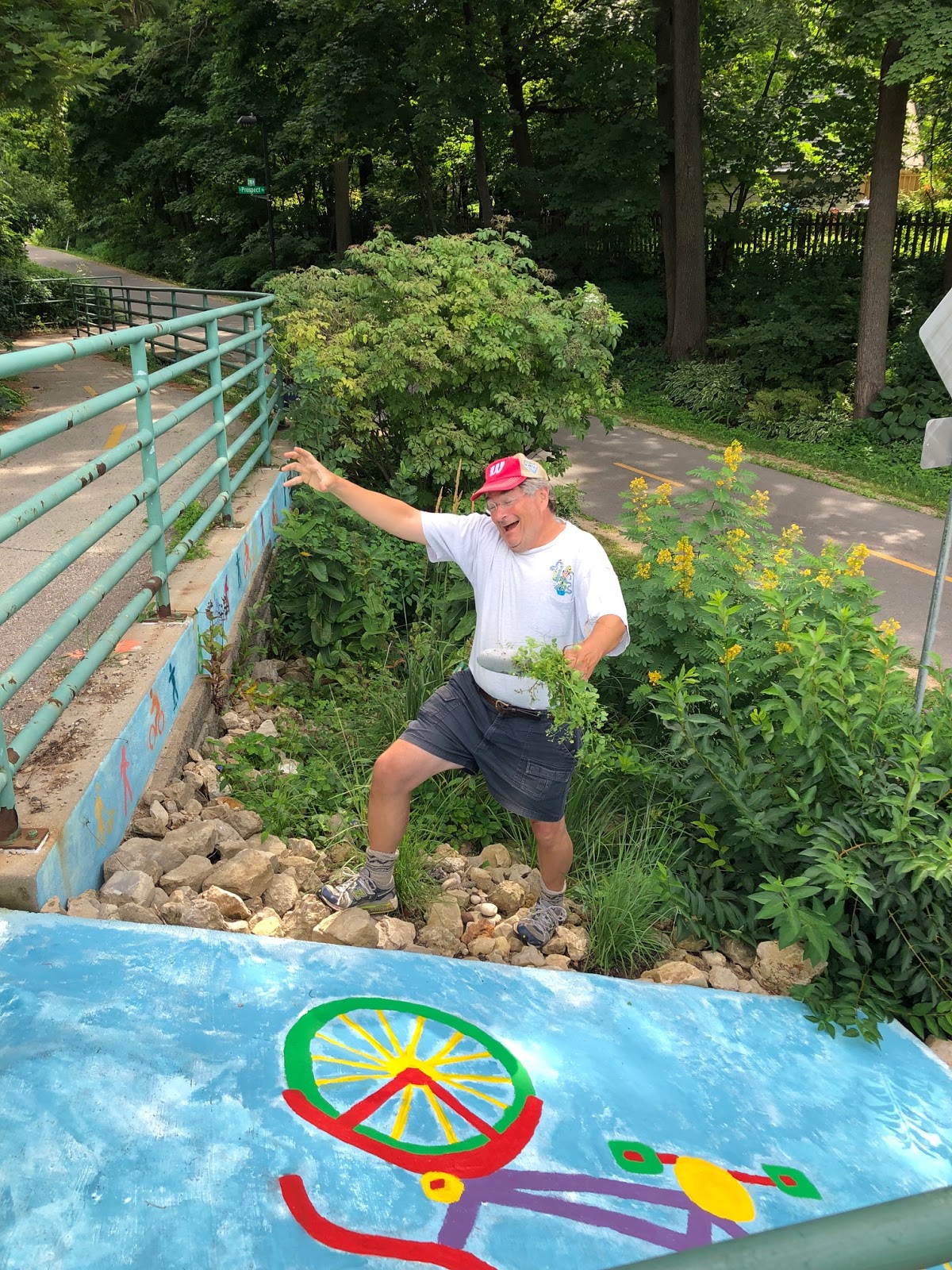
Hanns demonstrating one of the skills sometimes needed while gardening on a slope with rocks. Maintaining balance while holding onto a handful of weeds is sometimes required. However, there is plenty of flatland in Prospect Gardens that volunteers can choose. It is not necessary to have "goat like" abilities.

Hanns proved to be quite adapt. Not bad for a guy who was adjusting to Wisconsin time after a long trip from Hawaii.

Laura is removing plants including Black Eyed Susans.  Laura is accomplished at pulling weeds regardless of the angle of the slope. Here the terrain is relatively flat.


Here is Joyce working near Laura. Another accomplished Prospect Gardener and willing to work on any terrain.


Loren getting ready to leave on his electric bike.

A heartfelt thank you to Loren, Laura, Joyce, Erich, Steve, Hanns, Jody, and Mary for joining Ann and I. Together we journeyed down one of August's lanes on a day filled with the sentiments expressed in  Edgar Albert Guest's poem.

"All the world's in color now, and all the song birds sing;
Never reds will redder be, more golden be the gold,
Down the lanes of August, and the summer getting old."

Enjoy these aging days of summer.


Tuesday, July 30, 2019

Refuge and Summer Beauty

July is fading into August. As I reflect on the disappearing July and time at Prospect Gardens finding refuge during a rather turbulent month emerges into consciousness. We experienced stormy weather and the political world continued to be turbulent. Usually, I can navigate through the political chaos with some calmness. However, after watching fifteen minutes of the Mueller hearings, I got on my working shoes, and went to Prospect Gardens. There I found refuge while removing rocks and making space for Little Blue Stem grasses donated by a neighbor. Yes, planting in mid summer is atypical. Watering will be required and the hardiest will survive.

During Sunday's walk I meandered through the University of Wisconsin Botanical Garden, located at 1090 University Avenue. A magnificent perennial garden, all plants duly identified, and with a small pond. As I crossed the bridge this water lily caught my eye. Here's a poem telling us what we can learn from the Water Lily. It's from the 2017 Wisconsin Poets' Calendar, a present from Sandy. Sandy is a poet and  the crew chief of the Glenway Prairie, about a 20 minute walk west of Prospect Gardens.

How to Live Like a Water Lily (Annette L. Grunseth)
Wake up slowly, float in a dreamy world,
silky arms folded over your face until mid-morning,
then open wide, sun-warmed awake.
Breathe from more than one place, soft and supple.
Do not worry about today or tomorrow
or care what others think of you.
Your radiant center is tough, strong,
nourished by water and light.
Wind and wave may engulf you
but you can easily separate from submersion,
opening your face to the heavens.
Push back beads of wet darkness.
Move freely. Make white water circles until afternoon,
when you fold softly back into yourself,
 drowsing in the dimming daylight.


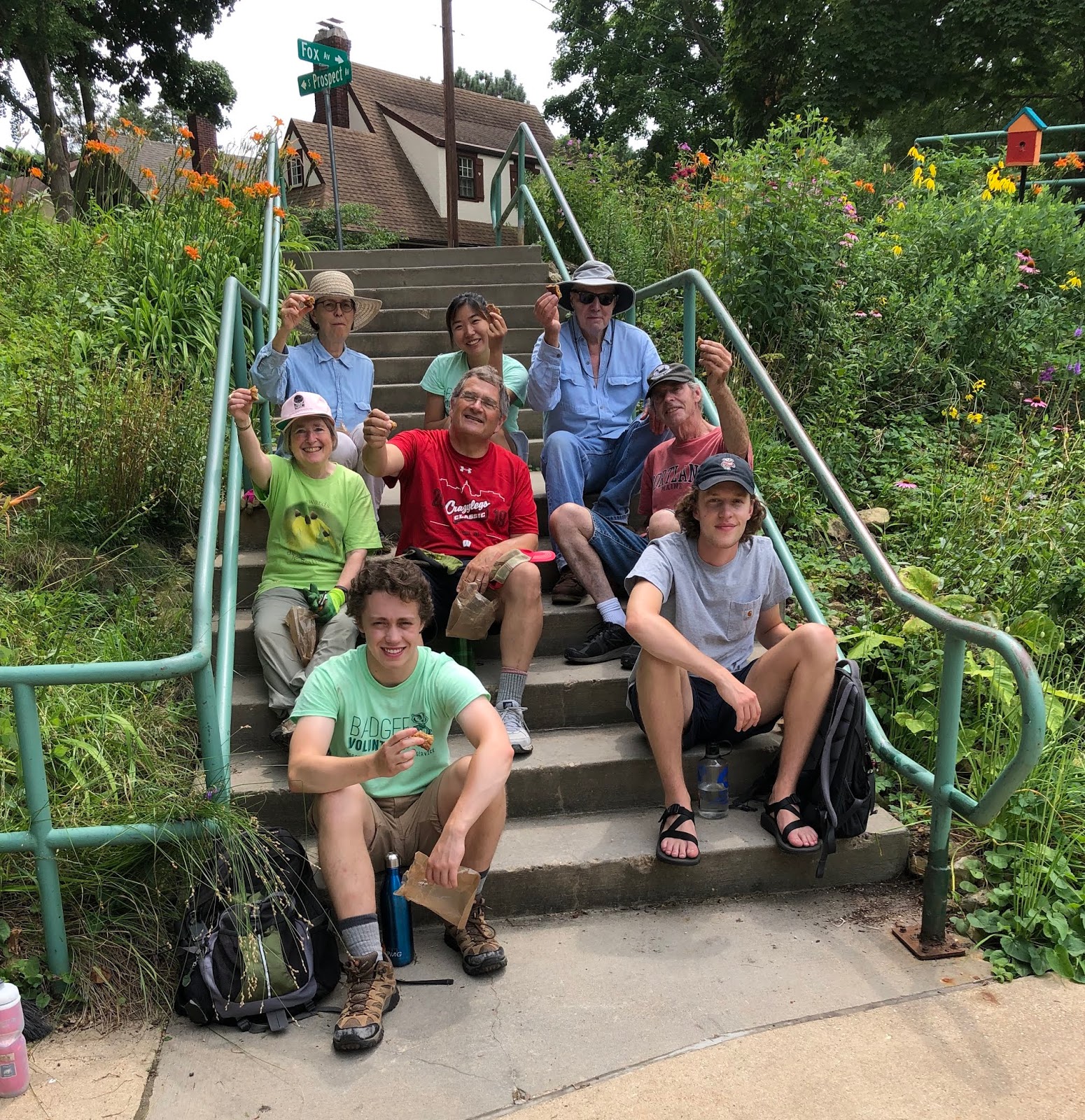
The poem's message is worthy of reflection as we move further into the dog days of summer. The poem also reminded me how Prospect Gardens is a refuge for me and I would hope for others. As I tend the Gardens with the help of volunteers, I also experience community and connections. Here's the July 26th crew. We are holding butterscotch oatmeal bars made by Ann, my wife, while toasting her as she took the picture.

Two UW Badger Volunteers returned: Joe sitting on the left side of the first step and Connie, in the middle of the back row. Two more Badger volunteers, Ethan and Sameer, were taking exams.

Accompanying the UW Badger Volunteers is Sam, an intern with Wisconsin Environmental Initiative, (WEI). He's sitting to Joe's left and on the first step. WEI, led by John Imes, is the sponsor of these particular Badger Volunteers. Blog readers will recognize Sam, Joe and Connie because they were part of the crew that tended the Gardens in June. Behind Sam is Steve and on the same step are Hanns and Joyce. In the back row, flanking Connie, are Ann N. and me.

The weather was quite pleasant and the afternoon quickly slipped by. Much was accomplished including thinning out a species of aggressive, overgrown Black Eye Susan plants.  Joyce, in the green t-shirt, Sam, and Ann N. without hesitation did the job. 


Here's Joe, Connie, and Steve in the background. They are clearing out an unknown weed that carpeted this section of the Garden.


.

I had to include this one of Joe giving the "thumps up" to a productive afternoon as well as one filled with conversation and humor.

This particular team of Badger Volunteers is finishing the summer term of working with John Imes' Wisconsin Environmental Initiative. Another team will join John as the Fall semester unfolds.

Thank you John for the opportunity to interact with these hard working and enthusiastic future UW alumni.

I bid farewell and send best wishes to Sam, Justine, Joe, Connie, Ethan and and Sameer as they finish their degrees and move forward with their lives.  May you be safe, may you be well, may you be strong and may you be happy.

I would be remiss if I didn't feature ten pictures showing the Gardens' summer beauty. This beauty contributes to the Gardens being a refuge for birds, insects and human beings.

Swamp Milkweed, a favorite of Monarch Butterflies. I wish I had more. Hopefully this clump will continue to flourish and spread.

Incidentally, the "Blooming Butterfly" show is still on through August 11th at Olbrich Gardens, here in Madison. A variety of free-flying butterflies, including the Monarchs, will dazzle you as you walk through the Bolz Conservatory. The domed tropical conservatory is another soothing refuge and especially during the winter months.


I can't recall the name of this stately lavender beauty.  Nate, the Oregon teacher and lead for the school district's gardens, donated these several years ago. Nate's daughter got married a few weeks ago in the small park that adjoins the family home. It rained heavily in the morning. The skies cleared in time for the afternoon wedding. A good omen for a long and happy married life for the young couple.
A species of Black Eye Susan and the ones I like. These are shorter, compact, have larger blooms and know how to live with their neighbors. They are the opposite of their aggressive taller cousins which many are now on the pile of plant material waiting to be picked up by the city.
A Purple Cone surrounded by cultivated Phlox. Perennials and natives living together in beautiful harmony. The name is from the Greek word phlox meaning flame in reference to the intense flower colors of some varieties. Easy to grow while being subject to powder mildew.
The brilliant Coreopsis, maybe "Early Sunrise" species, spilling out of its bed. Sunshine at your finger tips. These also attract butterflies.
The delicate, yet hardy, Yellow Coneflower, a native that returns and spreads. This one's ancestors were in the gardens of our former home on Keyes Avenue. I planted them well before we sold and moved into our apartment, three years ago in August. Time is certainly slipping by. 
Here's the white spikes of Culver's Root. This year this hardy plant has migrated from it's original location on the flat Regent Neighborhood section of the Gardens down the slope to a site a few feet from the bike path.

As the years pass, plants migrate with the result being constant changes in the appearance of the Gardens. These migrations remind me that change and impermanence is a constant of life.
Prospect Gardens and other prairie gardens along the Southwest Path provide refuge for the generations of migrating Monarchs. Here the magnificent Purple Cone is providing nourishment for the majestic Monarch.


This White Cone flower, sometimes referred to as the "White Swan," is a cultivar rather than a native. Like the Purple Cone, butterflies and bees flock to the blooms. Songbirds love the seeds of both the white and purple cone flowers. This bee didn't mind at all as I closed in and snapped the picture.


Ah, the regal Queen of the Prairie, one of my favorites. I celebrate the return of these pink, airy blooms. Last year an unknown fungus purged most of the Queens. Apparently cutting down and removing the infected plants helped. Sometimes the fungus can linger in the soil.  Long live the Queen!

I invite you to visit Prospect Gardens. Experience its beauty while taking refuge from the divisiveness of our era. Meanwhile I leave you with one of my favorite Wendell Berry poems extolling nature as a refuge.

 The Peace of Wild Things

When despair for the world grows in me
and I wake in the night at the least sound
in fear of what my life and my children’s lives may be,
I go and lie down where the wood drake
rests in his beauty on the water, and the great heron feeds.
I come into the peace of wild things
who do not tax their lives with forethoughts
of grief. I come into the presence of still water.
And I feel above me the day-blind stars
waiting with their light. For a time
I rest in the grace of the world, and am free.


Monday, July 1, 2019

UW Badger Volunteers and Gratitude

On the first day of summer, June 21st, a new crew of University of Wisconsin Badger Volunteers and their supervisors, tended the Prospect Gardens. A perfect afternoon for gardening. Temperature in the low 70's and with a light cloud cover.

The four Badger Volunteers, in lime green t- shirts, starting from the left to right are Joe, Sameer, Ethan and Connie. In the back row are Justine, the Program Coordinator for the Wisconsin Environmental Initiative (WEI) and Sam. He is replacing Justine who shortly will be leaving for Olympia, WA. Justine, serving an Americorps term, will join Capitol Land Trust in Olympia, WA, as their Restoration Coordinator. Justine will be involved in volunteer management, public education, and conservation efforts in the region.

WEI, directed by John Imes, sponsors the crew and through John's generosity, crews work in the Gardens several times during the gardening season.  This crew will be with WEI for the summer and will be involved with other WEI initiatives.

With deep gratitude I thank this crew, the UW Morgridge Center for Public Service, developers of the Badger Volunteer program, and John Imes for making his crew available. Before I share more for your reflection, here is Carrie Newcomer's poem, "Three Gratitudes."

Every night before I go to sleep
I say out loud
Three things that I’m grateful for,
All the significant, insignificant
Extraordinary, ordinary stuff of my life.
It’s a small practice and humble,
And yet, I find I sleep better
Holding what lightens and softens my life
Ever so briefly at the end of the day.
Sunlight, and blueberries,
Good dogs and wool socks,
A fine rain,
A good friend,
Fresh basil and wild phlox,
My father’s good health,
My daughter’s new job,
The song that always makes me cry,
Always at the same part,
No matter how many times I hear it.
Decent coffee at the airport,
And your quiet breathing,
The stories you told me,
The frost patterns on the windows,
English horns and banjos,
Wood Thrush and June bugs,
The smooth glassy calm of the morning pond,
An old coat,
A new poem,
My library card,
And that my car keeps running
Despite all the miles.

And after three things,
More often than not,
I get on a roll and I just keep on going,
I keep naming and listing,

Until I lie grinning,
Blankets pulled up to my chin,
Awash with wonder
At the sweetness of it all."
As we ended the afternoon and packed up the tools and returned this wheelbarrow to its owner, I felt grateful for the opportunity to enjoy a summer afternoon with future UW alumni. You could say  I was "awash with wonder at the sweetness of it all."


Here's Justine observing a spider on her arm during an April work session when she and another crew of Badger Volunteers tended the Gardens. I wish the best to her as she ventures to Olympia and begins her new job. She is excited about moving to the Northwest. Justine will do very well in her new job.

Justine and I teamed to create a new bed which first involved  removing rocks. We took turns hauling the rocks in a wheelbarrow up the northern ramp. The rock pile awaits pick up by the city.

I will fill the space with dirt and plant natives and maybe some grasses. Nate, an Oregon teacher and lead for its school prairie, has set aside Blue Lobelia and Little Blue Stem grasses. Maybe early next week  I will do the planting.

Sam, pictured here pulling weeds, is  an environmental science major and will be a senior this fall semester. Recently he's been biking many of our nearby trails. He also loves cast and fly fishing and especially near his hometown of Viroqua. Thanks Sam for your good work which included pulling Bishops Weed.

Viroqua's population is nearly 4,400 and is located about 94 miles northwest of Madison. Viroqua is the county seat of Vernon County. The county and surrounding areas are part of the unique Driftless region which covers about 20,000 square miles in western Wisconsin, northeastern Iowa, southeastern Minnesota, and extreme northwestern Illinois. This area was never glaciated, resulting in landscapes of steep, forested ridges, and deeply-carved river valleys.

Besides it's natural beauty, the Viroqua area is known for being one of the greatest organic farming regions of the  United States. Organic Valley, the largest organic farming cooperative in North America, is just one of the many organic farms that provide products to restaurants in Viroqua and across the Midwest.

The town and the area has a special place in my heart. Prior to retiring, I was the evaluation coordinator for the UW Environmental Resource Center. I'm grateful for the eight years of being on a team dedicated to addressing environmental issues.

We had a two day staff meeting held at the visitors center of The Kickapoo Valley Reserve, 23 miles east of Viroqua. A majestic setting on  8,600-acre of public land.

The Kickapoo River, a 126-mile-long tributary of the Wisconsin River, flows through the Reserve. Sandstone outcroppings tower over the River and native plants and animals abound in all seasons throughout the Reserve. Great fishing, and I bet Sam has fished in or near the Reserve.

During break, we talked about our least favorite buildings on campus. Sam disliked the Noland Zoology building. Joe nominated the George L. Mosse Humanities building pictured here. A few years ago the walk bridge was removed from this concrete colossus. Surprisingly, Sam liked the Humanities building, even though its design is similar to the Zoology Building.

Talking about buildings reminded me of my four years on the campus and how grateful I am for my UW education. Those were transformative  years for me when the Zoology and Humanities building were under construction. Also, UW was one of the epicenters of the Vietnam War protests during those years.

Construction of the Humanities Building began in 1966 when I was a senior, and in the fall began a Master's Degree program in Political Science. It and the Zoology building was completed in 1969. That year I still lived in Madison and was finishing my first year of teaching 7th and 8th grade social studies in Poynette with a Masters degree and teacher certification earned in 1968.

I recall walking past the Humanities Building as it was being built. The site was surrounded by a ply wood barrier covered with graffiti and anti-war slogans. According to a popular myth, the architect designed the structure to be riot proof. Supposedly, the design would impede protesters from occupying the building, as was done on October 18, 1967 when students took over the Commerce building. Known as the "Dow Chemical Riots", police waded into Commerce and dispersed the students with what would now be called excessive force.

I now stroll pass the Humanities Building on my occasional walks through campus. The massive building is a prime example of the 1960's Brutalist architectural movement. Brutalist designed buildings are large scaled concrete structures with a stark appearance featuring minimalist geometric patterns, straight lines and unadorned concrete exterior and interior surfaces. The architect was Harry Weese, the same man who designed Washington, D.C.’s iconic metro stations.

The UW master plan calls for the demolition of Humanities sometime in the future which has stirred up  controversy. Here's what Joe Reuteman, in the December 5th, 2015 Badger Herald said:

"The severe cement facade strikes many as overly imposing, looking less like a hub of arts and history and more like a munitions plant from some bleak dystopian fiction. The interior can be equally off-putting for new visitors, who often critique the layout of corridors, rooms, and stairwells as segmented and counter-intuitive."

However, Humanities has its supporters such as UW alumnus Virgil Abloh , the fashion designer and artistic director of Louis Vuitton's men's wear collection. Perhaps Sam, as a future alumnus, will have a voice in resolving the controversy.

Another future alumnus is Joe. Here's Joe returning from dumping a pile of weeds. Joe is beginning his senior year and double majoring in Environmental Studies and Economics.

Joe is from Wauwatosa, WI, a suburb of Milwaukee. Joe joined Badger Volunteers because he enjoys being a part of a cause that is greater than himself. Your generous spirit and hard work is greatly appreciated.


Here's Ethan with Justine. Ethan, his international name, is from China. His majors are mathematics and economics. 

Ethan now has two courses and an internship as a Data Analyst for the Wisconsin Educational Research Center. He joined the Badger Volunteers to get a break from a lot of time sitting and looking at the laptop screen. Being a Badger Volunteer also satisfies his desire to help preserve nature. Thank you, Ethan.


Connie, her international name, is also from China. She was born in a small village, and reflecting trends in China, moved with her family to a city. When living in the village she   gardened with her Grandmother.

Connie is biochemistry major with a computer science minor. Connie joined UW Badger Volunteers because she wants to be more engaged in the community and specifically in environmental protection efforts. She is pleased to be with the Wisconsin  Environmental Initiative (WEI). I am equally pleased and grateful that Connie spent the afternoon tending the Prospect Gardens.   


Ethan and Connie in action. The two made a great team. They worked diligently while seeming to enjoy themselves. Thank you.


Here's Sameer removing Jewel Weed. His hometown is Kenosha. His major is electrical engineering with an emphasis on embedded systems. According to my Google search, embedded systems is a new discipline that intersects  Computer Science and Electrical Engineering. Embedded systems dominate every aspect of human life. Applications are used in automobiles, TVs, cell phones, tablets, house appliances, house automation, and many other domains. In other words, all the electronic gadgets in our lives involve embedded systems.

Sameer joined Badger Volunteers because he felt it was good opportunity to meet new people and help the community at the same time. Thanks for helping our community and especially Prospect Gardens.


Gardening with the UW Badger Volunteers, Sam and Justine, to borrow from Newcomer's poem, is another example of the "Extraordinary, ordinary stuff of my life." I look forward to this crew's return.

The efforts of volunteers over the ten years since the Gardens began means that colorful areas such as this one greet passersby.The Poppy Mellows are in full bloom and dominate the area.

The Poppy Mellows are well established and like magic return each year. Yet they and all sections of the Gardens must be maintained which means that the need for volunteers is constant. The next neighborhood work session will be July 20th, 9 to noon. If you are in Madison, please join me. Many other plants will be in boom and perhaps the raspberries will be ready to pick.